The Lore of Bigfoot

Explore the legends, history, and theories surrounding Sasquatch and similar creatures.

From Ancient Traditions to Modern Mystery

Long before the name "Bigfoot" appeared in newspapers, stories of large, mysterious, humanlike beings were part of traditions throughout regions of North America. Over generations, Indigenous traditions, frontier accounts, newspaper reports, footprint discoveries, photographs, films, and eyewitness testimony became intertwined with what is now commonly called the Sasquatch phenomenon.

The modern search for Bigfoot occupies an unusual place between history, folklore, eyewitness testimony, scientific inquiry, and popular culture. Some reports remain unexplained, while others have been attributed to misidentification, fabrication, or hoaxes.

This collection explores that history without assuming that every report has the same explanation. Documented events are presented as history, eyewitness encounters as reports, traditional stories within their cultural context, and scientific ideas as hypotheses rather than established fact.

A History of the Mystery

From early traditions and frontier accounts to the events that created the modern Bigfoot phenomenon.

A Bigfoot Timeline

The modern story of Bigfoot developed over generations. These milestones helped shape the mystery as it is known today.

Before Written Records

Indigenous Traditions

Indigenous peoples of the Pacific Northwest and other regions maintained distinct oral traditions involving powerful, wild, or humanlike beings long before the modern Bigfoot phenomenon.

These traditions belong to individual peoples and cultures and should not all be interpreted as descriptions of a single modern creature.

1800s

Frontier Accounts

As explorers, traders, settlers, and newspapers documented the western wilderness, stories began appearing about unusual tracks and encounters with large, humanlike figures.

Such historical accounts vary greatly in detail and reliability, but they demonstrate that stories of mysterious wild beings existed well before the twentieth-century Bigfoot craze.

1958

Bluff Creek and the Name "Bigfoot"

Large humanlike footprints discovered around a road construction project near Bluff Creek in Northern California attracted newspaper attention.

The Humboldt Times used the memorable name "Bigfoot," helping transform scattered stories of mysterious creatures into a nationally recognized phenomenon.

1967

The Patterson-Gimlin Film

Roger Patterson and Bob Gimlin filmed a large, hair-covered, bipedal figure at Bluff Creek, California.

The short film became the most famous piece of alleged Bigfoot footage ever recorded. Decades later, supporters and skeptics continue to debate what the film actually shows.

1969

The Bossburg Tracks

A series of large tracks discovered near Bossburg, Washington, generated extensive investigation and renewed public attention.

Some tracks appeared to show an unusual deformation of one foot and became known as the "Cripplefoot" tracks. Investigations and later claims of hoaxing left the episode controversial and unresolved.

1970s

Organized Investigation

Growing public interest led researchers and organizations to collect eyewitness reports, footprint casts, photographs, hair samples, and other alleged evidence.

The period helped move Bigfoot investigation beyond newspaper stories toward more organized attempts at documentation.

1976–1977

Bigfoot and the FBI

Correspondence preserved by the Federal Bureau of Investigation documents a request connected with alleged Bigfoot hair samples and the FBI's examination of submitted material.

The existence of an FBI file is an interesting part of Bigfoot history, but it should not be interpreted as evidence that the FBI confirmed the existence of Sasquatch.

Explore the FBI Bigfoot File →
Modern Era

The Search Continues

Digital cameras, trail cameras, audio recorders, thermal imaging, mapping systems, drones, and other technologies have transformed how modern investigators document and evaluate reports.

Despite decades of sightings and investigation, Sasquatch has not been formally recognized by mainstream zoology as a documented species. The continuing divide between reported encounters and definitive biological evidence remains at the heart of the mystery.

Famous Encounters

Cases, footprints, films, and reports that helped shape the modern Sasquatch mystery.

Cases That Shaped the Legend

Some reports have become landmarks in Bigfoot history. Their significance does not necessarily establish what caused them, but each played an important role in shaping public interest and the continuing search for Sasquatch.

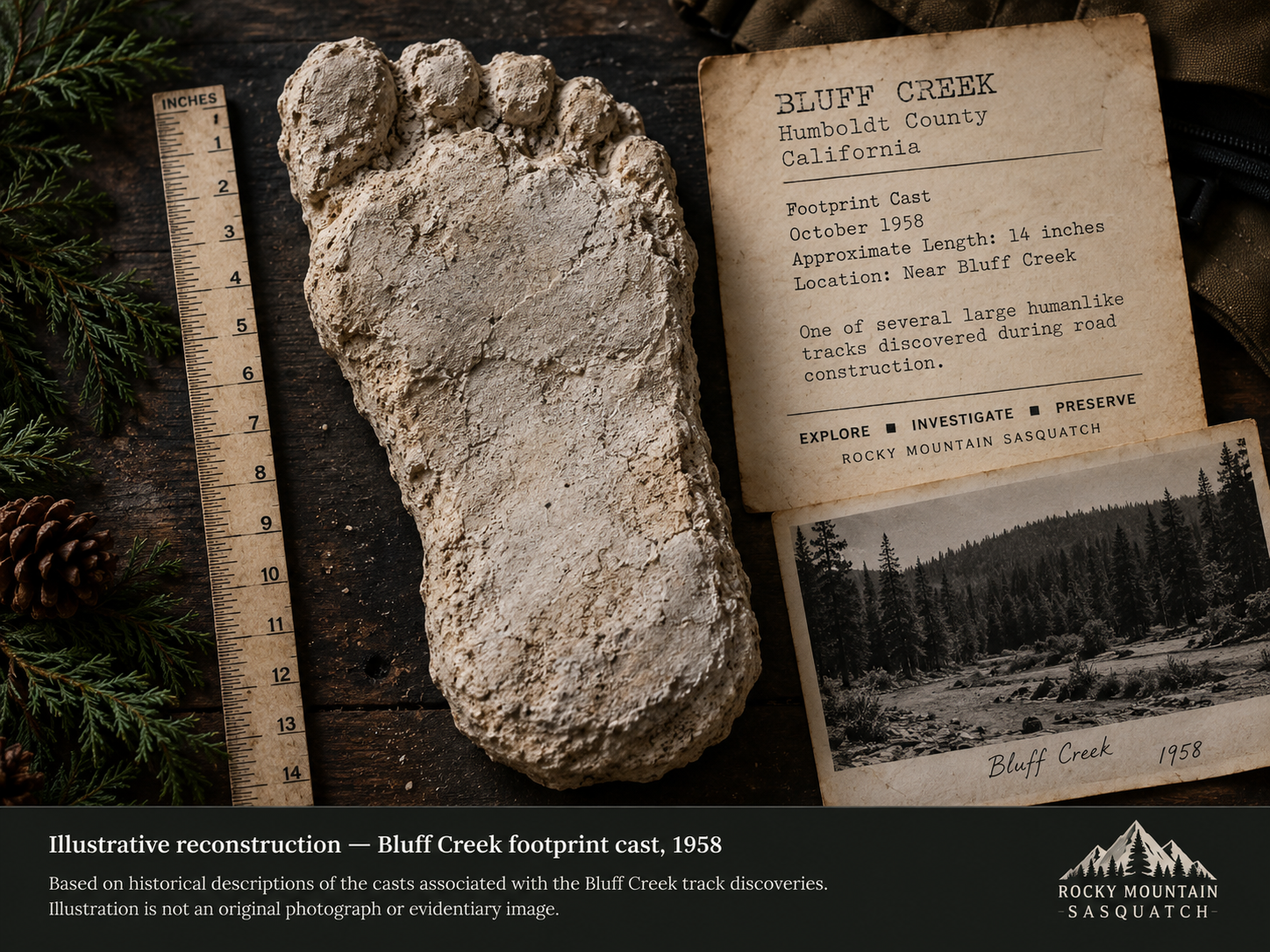
Illustrative reconstruction of a 1958 Bluff Creek footprint cast displayed with archival-style field notes and measuring scale
Illustrative reconstruction — Bluff Creek footprint cast, 1958 RMSO-created illustration based on historical descriptions. Not an original photograph or evidentiary image.

1958 · Bluff Creek, California

The Footprints That Gave Bigfoot Its Name

During road construction in the remote forests of Northern California, workers reported discovering enormous humanlike footprints around their equipment near Bluff Creek.

The tracks attracted the attention of the Humboldt Times, whose coverage helped popularize a remarkably effective name for whatever had supposedly made them: "Bigfoot."

Decades later, relatives of road contractor Ray Wallace said that Wallace had created footprint hoaxes using carved wooden feet. That revelation placed important portions of the 1958 episode under serious doubt, while the name born from the story became permanent.

Historical significance: Birth of the modern "Bigfoot" name and media phenomenon.
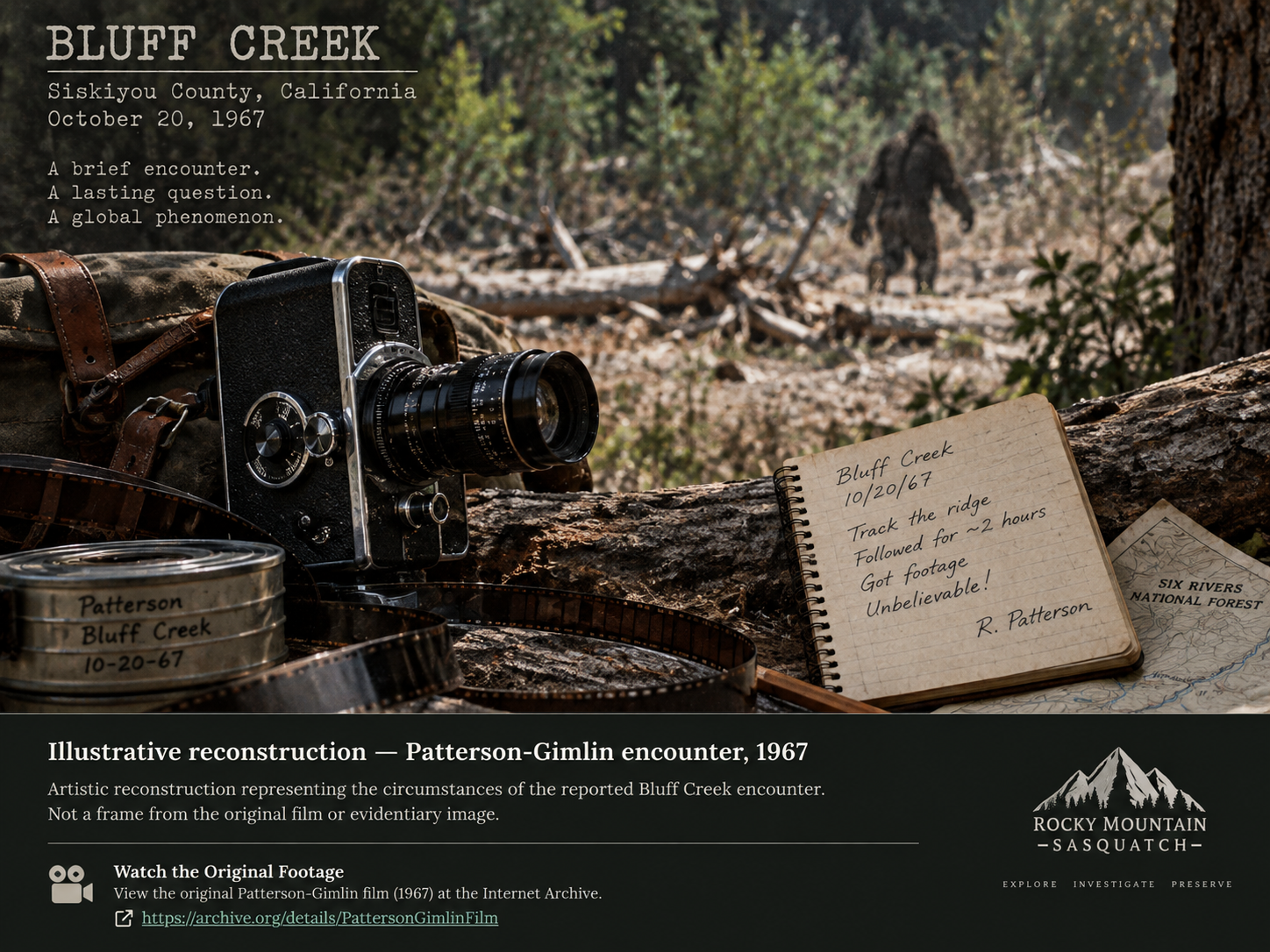
Illustrative reconstruction of the 1967 Patterson-Gimlin encounter at Bluff Creek with a film camera, field notes, and a distant unidentified figure
Illustrative reconstruction — Patterson-Gimlin encounter, 1967 RMSO-created illustration representing the circumstances of the reported Bluff Creek encounter. Not a frame from the original film or an evidentiary image.

October 20, 1967 · Bluff Creek, California

The Patterson-Gimlin Film

Roger Patterson and Bob Gimlin were traveling through the Bluff Creek area when Patterson filmed a large, dark, hair-covered figure walking across a clearing.

The resulting footage lasts only a short time, but the walking figure captured on film became one of the most recognizable images associated with Sasquatch anywhere in the world.

Supporters have pointed to the figure's proportions, movement, and apparent musculature as reasons to consider the film significant. Skeptics have argued that it depicts a person wearing a costume. More than half a century later, the footage remains disputed.

Status: Historically documented film; identity of the filmed subject remains disputed.

View the Historical Film

The complete Patterson-Gimlin film reel is available through Wikimedia Commons, where it is preserved as a public historical media file.

Watch the Patterson-Gimlin Film on Wikimedia Commons →
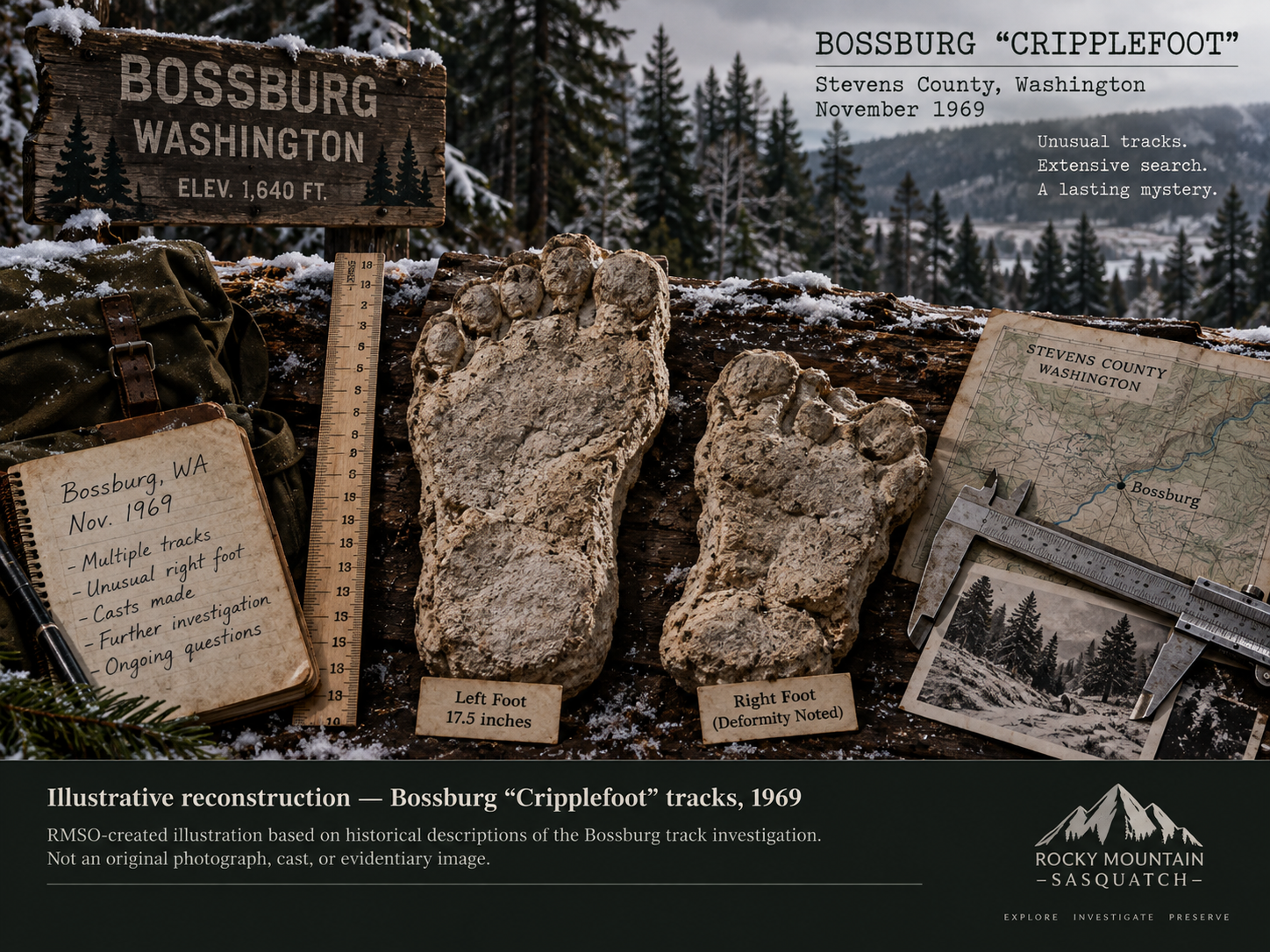
Illustrative reconstruction of the 1969 Bossburg Cripplefoot track investigation showing footprint casts, measuring equipment, field notes, and a Washington winter setting
Illustrative reconstruction — Bossburg "Cripplefoot" tracks, 1969 RMSO-created illustration based on historical descriptions of the Bossburg track investigation. Not an original photograph, cast, or evidentiary image.

NOVEMBER 24, 1969 · BOSSBURG, WASHINGTON

The Cripplefoot Tracks

Large footprints discovered near Bossburg, Washington, triggered an extensive search of the surrounding area. Searchers eventually documented a long series of tracks crossing varied terrain.

Particular attention centered on impressions showing what appeared to be a deformed right foot. The unusual anatomy led to the nickname "Cripplefoot" and made casts of the tracks especially interesting to investigators.

British primatologist John Napier later examined casts and photographs and discussed the apparent deformity. The Bossburg investigation also became entangled with hoax claims, leaving the episode controversial rather than conclusive.

Status: Extensively documented footprint event with disputed interpretation.

Explore the Historical Record

HistoryLink, Washington State's online encyclopedia, documents the 1969 Bossburg track discoveries and the investigation that followed.

Read the Bossburg History on HistoryLink →

Older Than the Name Bigfoot

Indigenous traditions and regional stories of wild, humanlike beings long predate the modern Sasquatch phenomenon.

Traditions of the Mountains

The Rocky Mountains were home to Indigenous peoples for countless generations before the modern terms "Bigfoot" or "Sasquatch" entered popular culture.

Nations connected to the Rocky Mountain region developed their own histories, oral traditions, languages, and relationships with the mountains and the beings described within them. These traditions are culturally distinct and should not be treated as different names for a single modern creature.

Stories involving giants, wild people, unusual beings, or inhabitants of remote places are sometimes compared with modern Sasquatch reports. Such comparisons can be interesting, but similarity does not establish that the original tradition was describing what people today call Bigfoot.

A note on interpretation

RMSO presents Indigenous traditions in their cultural and historical context whenever reliable sources are available. We distinguish the tradition itself from later attempts to interpret it through the modern Sasquatch phenomenon.

ROCKY MOUNTAIN REGION

Ute Traditions and the Siants

A documented tradition — and an important distinction

The Ute people have deep historical connections with the Rocky Mountains and surrounding regions of the interior West. Their oral traditions include accounts of beings known in published ethnographic collections as Siants.

Ethnologist Anne M. Smith recorded Uinta, White River, and Uncompahgre Ute stories during her work among Ute communities in the 1930s. Her collection, later published as Ute Tales, contains multiple narratives identified as "Siants," showing that the tradition was not limited to a single recorded story.

Modern sources sometimes connect the Siants with Bigfoot. There is good historical support for Siants as beings within Ute tradition, including descriptions associating them with dangerous or man-eating figures. What the historical record does not establish is that the Siants were the same creature people today describe as Sasquatch.

What the Sources Support

Siants appear repeatedly in recorded Ute oral traditions collected from Uinta, Uncompahgre, and White River storytellers.

What Remains Interpretation

Identifying the Siants specifically as Bigfoot, Sasquatch, or an undiscovered biological species goes beyond what these historical sources establish.

Explore the Historical Source

The University of Utah Press publishes Anne M. Smith's collection of Uinta, White River, and Uncompahgre Ute narratives as Ute Tales.

Explore Ute Tales — University of Utah Press →

GREAT BASIN · INTERIOR WEST

Shoshone Traditions — Similar Stories, Different Beings

Looking for similarities without ignoring the differences

Historical collections of Western Shoshone oral traditions describe a diverse world of beings rather than a single creature resembling the modern idea of Sasquatch.

Anne M. Smith's collection Shoshone Tales, based on stories recorded in 1939, separately preserves narratives involving Tso'apittse, Si-ets, cannibal giants, water beings, supernatural figures, animals, and other characters.

Some of these traditions contain characteristics that can invite comparison with modern Sasquatch reports. Others contain characteristics that make such an identification considerably more difficult.

Tso'apittse

Recorded traditions describe a dangerous giant associated with remote landscape features including mountain springs and caves.

Large size and association with remote country create a surface resemblance to some modern Sasquatch reports. The tradition's dangerous and cannibalistic character, however, should not be ignored when making that comparison.

Si-ets / Watoavic

A Western Shoshone tradition documented in later cultural-resource research describes Watoavic, identified there with Si-ets, as a man made of stone associated with Steptoe Mountain.

That description differs substantially from the hair-covered biological creature usually proposed in modern Sasquatch research.

Where Does the Sasquatch Comparison Hold Up?

Large or giant stature Possible parallel
Association with remote mountain country Possible parallel
Humanlike form Partial / tradition dependent
Hair-covered body Not established by these sources
Large humanlike footprints Not established by these sources
Cannibalistic behavior Major difference
Stone / supernatural characteristics Major difference
RMSO assessment

There are characteristics within some Shoshone traditions that resemble elements of modern Sasquatch reports. Based on the historical material examined here, however, there is not enough evidence to identify these traditional beings simply as early descriptions of Sasquatch.

The similarities are worth documenting. The differences are equally important.

Explore the Historical Sources

Anne M. Smith's Shoshone Tales preserves the Western Shoshone narratives used as the starting point for this comparison.

Explore Shoshone Tales — University of Utah Press →

COAST SALISH · BRITISH COLUMBIA

Sts'ailes, Sa:sq'ets and the Origin of "Sasquatch"

An Indigenous tradition that gave the modern mystery its name

Long before "Bigfoot" became a newspaper headline in 1958, the Sts'ailes people of British Columbia had traditions associated with a being known as Sa:sq'ets.

Sa:sq'ets remains culturally significant to the Sts'ailes today. Sts'ailes sources describe Sasquatch as an important part of their cultural identity and spiritual beliefs, and describe Sa:sq'ets as a caretaker who watches over the land.

The word familiar to millions of people today entered the wider English-speaking world through a different route. In 1929, J. W. Burns published an article titled Introducing B.C.'s Hairy Giants, presenting accounts he had gathered from Indigenous people in British Columbia. The English word "Sasquatch" became associated with those accounts and is an anglicized form of the Sts'ailes name Sa:sq'ets.

An important distinction

The modern popular image of Sasquatch should not simply be projected backward onto Sts'ailes tradition. Sa:sq'ets has its own cultural and spiritual meaning. Burns' writings helped introduce an English-speaking audience to Indigenous accounts, but they also presented those accounts through the perspective and language of an outside writer.

What Makes This Comparison Significant?

Humanlike form Present in historical accounts
Large stature Present in historical accounts
Hair-covered body Present in historical accounts
Remote mountain / wilderness association Present in historical accounts
Rare or elusive encounters Present in historical accounts
Connection to the word "Sasquatch" Historically supported
Unknown biological primate Not established
RMSO assessment

Unlike traditions that share only a general characteristic such as giant stature or residence in remote country, the historical accounts associated with the emergence of the word "Sasquatch" contain a notable cluster of characteristics also found in modern reports: large stature, humanlike appearance, extensive body hair, wilderness association, and rarity of encounters.

That similarity does not establish Sa:sq'ets as an undiscovered biological species. It does establish that descriptions resembling important elements of the modern Sasquatch phenomenon existed before the name "Bigfoot" entered popular culture.

Explore the Cultural and Historical Sources

The Sts'ailes tell the continuing cultural story of Sa:sq'ets through their own organizations. J. W. Burns' 1929 article provides an important historical record of how "Sasquatch" entered wider English-language use.

Sts'ailes — Story of the Sasquatch →
Read J. W. Burns' 1929 Article →

OREGON COAST · NEHALEM RIVER

Nehalem Tillamook — The Wild Man

Large humanlike beings, immense tracks, and stories preserved by an identifiable Indigenous storyteller

Among the traditions recorded from the Nehalem Tillamook of the northern Oregon coast are accounts of beings described in English as Wild Men.

These accounts are especially valuable because their source can be identified. Nehalem Tillamook storyteller Clara Pearson related an extensive body of traditional narratives to ethnographer Elizabeth Derr Jacobs during the 1930s. Pearson had learned many of the stories from earlier generations, including her father.

Several of Pearson's Wild Man accounts contain physical and behavioral details that make comparison with modern Sasquatch reports unusually interesting.

Tracks approximately three feet long

In one account, a man living with his family upriver discovered that something had torn open a corner of their house and carried away one of his wives. Outside, tracks were visible in the snow.

Pearson's narrative indicates tracks approximately three feet in length. Their extraordinary size caused the man to conclude that whatever had made them was not an ordinary person.

Following the tracks, the man encountered Wild Man beside a large fire. The story describes Wild Man as resembling a person while possessing abilities beyond those of an ordinary person. He carried equipment including a quiver and club and was capable of making and using fire.

Another Pearson account describes an encounter with an "extremely large" Wild Man. Other stories describe damage to a riverside fish-drying house followed by the discovery of huge tracks around the structure.

The narratives also portray Wild Men as more than animals. They display purposeful behavior, use objects, communicate, hunt, travel through the landscape, and interact with people. Pearson even related that there must once have been a number of Wild Men because they were encountered repeatedly.

Where Does the Sasquatch Comparison Hold Up?

Very large stature Supported in recorded accounts
Humanlike appearance Supported in recorded accounts
Extremely large humanlike tracks Supported in recorded accounts
Forest / remote-country association Supported in recorded accounts
Exceptional physical ability Supported in recorded accounts
Intelligence and tool use Supported in recorded accounts
Hair-covered body Not established by the material examined
Strong odor Not established
Unknown biological species Not established
RMSO assessment

The Nehalem Tillamook Wild Man narratives contain one of the stronger clusters of characteristics encountered in the traditions examined by RMSO so far. Large stature, humanlike appearance, enormous tracks, wilderness association, unusual physical ability, intelligence, and tool use all appear within the same recorded body of stories.

Particularly notable are the tracks described as approximately three feet long. Unlike a general story about a giant, footprints provide a specific physical characteristic that can be compared with later Sasquatch reports.

There are also important differences. The accounts contain elements of traditional narrative, including extraordinary abilities and behavior not typical of modern Sasquatch reports. The material examined does not establish a hair-covered body or demonstrate that Wild Man represented an unknown biological species.

The historical record therefore supports the existence of the Nehalem Tillamook Wild Man tradition and its unusual characteristics. Identifying those beings specifically as Sasquatch remains an interpretation.

Explore the Historical Record

Clara Pearson's narratives were recorded during ethnographic work in the 1930s and later published as Nehalem Tillamook Tales. Archival collections also preserve recordings connected with Pearson and the Tillamook language and storytelling tradition.

Oregon Encyclopedia — Bigfoot and Sasquatch in Oregon →

PUGET SOUND · WESTERN WASHINGTON

Tsiatko / Seatco — When a Tradition Changes in the Telling

From an 1863 "nocturnal demon" to later descriptions of mysterious mountain beings

Tsiatko, also rendered by later writers as Seatco and in other spellings, is frequently associated with Sasquatch in modern discussions of Pacific Northwest Indigenous traditions.

The historical record, however, is more complicated. Early sources do not provide the familiar description of a large, hair-covered, humanlike creature that is sometimes attributed to the tradition today.

1863 — George Gibbs

In his Dictionary of the Chinook Jargon, George Gibbs recorded Tsiatko as a term found among Chehalis, Nisqually, and neighboring peoples.

Gibbs defined Tsiatko simply as a feared "nocturnal demon." He did not describe its height, body covering, footprints, physical appearance, or method of movement.

Gibbs also recorded an important complication. He wrote that the Skagit applied the same name to an Indigenous people living along the Fraser River whom they feared. The term therefore cannot automatically be assumed to identify one specific biological creature.

1890 — Myron Eells

Nearly three decades later, missionary and ethnographer Myron Eells recorded a more elaborate Puget Sound tradition concerning beings he called the "Seatco or Mountain Indian."

In Eells' account, the Seatco lived in holes among rocks in distant mountains, slept during the day, traveled at night, and could carry people away.

But Eells also attributed wings and explicitly extraordinary characteristics to them. Those details differ substantially from the primarily biological creature described in most modern Sasquatch reports.

What Changes Across the Historical Record?

Nocturnal behavior Present in early sources
Remote mountain association Present in later 19th-century account
Humanlike terminology Present in later account
Large stature Not established by these early sources
Hair-covered body Not established by these early sources
Large humanlike footprints Not established by these early sources
Wings / supernatural characteristics Present in Eells' account
Unknown biological species Not established
RMSO assessment

Tsiatko / Seatco is historically significant to the study of Sasquatch traditions precisely because the evidence does not support a simple identification.

The earliest source examined by RMSO establishes a feared nocturnal being or concept, but provides no description of a large, hairy, humanlike creature. A later nineteenth-century account adds mountain habitation and nocturnal activity, while also adding explicitly supernatural characteristics.

Later descriptions of Tsiatko as essentially an Indigenous name for a large hairy forest creature should therefore be treated cautiously unless those characteristics can be traced to additional Indigenous sources.

Similarity to modern Sasquatch lore exists in some later characteristics, but the historical record also demonstrates how easily separate traditions, translations, and interpretations can become combined over time.

Explore the Historical Sources

George Gibbs' 1863 dictionary provides one of the earliest documentary references to Tsiatko. Myron Eells' 1890 account preserves a later and substantially more elaborate description of Seatco.

Read George Gibbs' 1863 Dictionary →
Read the 1890 Myron Eells Account →

COLUMBIA RIVER · CASCADES · PUGET SOUND

Stick Indians — One Name, Different Traditions

Wilderness beings, whistles, warnings — and a name that has not always meant the same thing

"Stick Indians" appears frequently in discussions of Indigenous traditions from the Pacific Northwest and is sometimes presented as another traditional name for Sasquatch.

The historical and cultural record is considerably more complicated. Different communities have used similar terminology for different beings and, in some historical contexts, for actual Indigenous people.

Rather than assuming that every reference describes the same creature, the individual traditions provide a better place to begin.

Wasco traditions — whistles in the woods

Warm Springs and Wasco artist Lillian Pitt described Stick Indians during a 2023 oral-history interview preserved by the Smithsonian Institution.

Pitt related that Stick Indians whistle like birds. They may guide a good person who is lost in the woods toward safety, or lead another person farther astray. She also recalled childhood warnings that Stick Indians could take misbehaving children during the night.

Suquamish traditions — similar, but not the same

Contemporary Suquamish cultural accounts provide an especially important distinction. Stick Indians are described as beings of the woods capable of leading people astray, while Sasquatch is discussed separately.

The traditions may share characteristics and occupy overlapping cultural landscapes, but the Suquamish account does not simply identify Stick Indians and Sasquatch as the same being.

The same account warns that whistling at night may attract the attention of Stick Indians or other beings, including Sasquatch — another indication that the concepts remain distinct.

A historical complication — "Stick Indians" could also mean people

Not every historical use of the term referred to a mysterious or supernatural being.

A Chehalis Tribal elder recalled Indigenous people traveling from Canada to gather berries and roots who were called "Stick Indians." She specifically explained that these were real people, not spirits.

Historical records likewise used similar terminology for Indigenous communities associated with inland or forest country. Context therefore matters whenever the term appears in an older source.

Where Does the Sasquatch Comparison Hold Up?

Forest / wilderness association Supported in some traditions
Mountain association Supported in some traditions
Whistling / birdlike vocalization Strongly represented
Purposeful / intelligent behavior Supported
Nocturnal association Present in some traditions
Large stature Not consistently established
Hair-covered body Not consistently established
Large humanlike footprints Not consistently established
Same being as Sasquatch Not established
RMSO assessment

Stick Indian traditions contain several characteristics that invite comparison with modern Sasquatch reports, particularly their association with remote forests, unusual whistles or birdlike sounds, nighttime activity, and apparently intelligent behavior.

Those similarities are worth documenting, especially because unusual whistles and vocalizations continue to appear in modern reports of unexplained encounters in wilderness areas.

The differences are equally important. The historical record does not consistently describe Stick Indians as large, hair-covered beings or associate them with the enormous humanlike footprints characteristic of modern Sasquatch reports.

Indigenous sources also demonstrate that "Stick Indian" has not always referred to one type of being. In some traditions the term concerns mysterious inhabitants of the wilderness; in other historical contexts it was applied to actual people.

RMSO therefore does not treat "Stick Indian" as another name for Sasquatch. The similarities remain interesting, but whether some traditions describe related phenomena is a question the available evidence does not resolve.

Explore the Cultural Sources

These sources provide Indigenous perspectives that illustrate both the similarities and the important differences found within Stick Indian traditions.

Smithsonian — Oral History Interview with Lillian Pitt →
Suquamish Tribe — Sasquatch and Stick Indian Traditions →
Chehalis Tribe — Honoring Our Elders →

SOUTHERN SIERRA NEVADA · CALIFORNIA

Tule River — Big Foot, The Hairy Man

A large shaggy-haired being, an enduring Tribal tradition, and an ancient rock-art site

On the Tule River Indian Reservation in the foothills of California's southern Sierra Nevada, stories of a being known as Hairy Man have been preserved across generations.

Unlike many traditions later associated with Sasquatch, the Tule River Indian Tribe itself publishes the story under the title Big Foot, The Hairy Man. The account was told by Tribal elders Ruby Bays and Jennie Franco and published in 1975 as part of a collection of traditional stories.

The description is unusually specific and contains several characteristics that can be directly compared with modern Sasquatch reports.

A great giant with long, shaggy hair

The Tule River story describes Hairy Man as a very large giant covered with long, shaggy hair. His hair gave him an animal-like appearance, although the narrative presents him as a distinct being rather than identifying him as an ordinary animal.

Hairy Man was associated with the hills surrounding Tule River. During hot summer nights, animals came down from the hills to drink, and Hairy Man was said to catch large animals near the river.

The story portrays Hairy Man as enormously powerful. Grizzly bears, mountain lions, wolves, and other large animals were among the creatures associated with his hunting.

People were particularly cautious near the river at night. Parents warned children not to stay out late or approach the river because they might encounter Hairy Man.

The tradition also associates him with powerful sounds. The story explains that when Hairy Man approaches along a trail at night, people can tell that something very large is coming from the magnitude of the sound.

Painted Rock — a much older cultural landscape

Near the Tule River is a culturally important archaeological site known as Painted Rock. The rockshelter contains pictographs along with other evidence of long-term human activity.

Research concerning the site estimates the pictographs to be approximately 1,000 years old. Tule River Tribal members identify figures within the rock art with Hairy Man and connect the site with traditional stories concerning the creation of people.

That distinction is important. The age of the pictographs establishes that the rock art itself is ancient. The identification of particular figures as Hairy Man comes from Tule River cultural tradition. Neither fact, by itself, demonstrates that the figure represents an unknown biological species.

Where Does the Sasquatch Comparison Hold Up?

Very large stature Explicitly described
Long, shaggy hair Explicitly described
Humanlike / giant form Explicitly described
Mountain / hill association Explicitly described
Nocturnal activity Strongly represented
Exceptional strength Strongly represented
Powerful sounds / movement Explicitly described
Large humanlike footprints Not established in this account
Unknown biological species Not established
RMSO assessment

The Tule River Hairy Man tradition contains one of the strongest clusters of Sasquatch-like characteristics encountered in the Indigenous traditions examined by RMSO.

Large stature, long shaggy hair, association with mountain country, nighttime activity, exceptional physical power, and sounds indicating the approach of something very large all occur within the Tribe's published account.

The tradition is particularly significant because the Tule River Indian Tribe itself preserves the story as Big Foot, The Hairy Man. The association is therefore not solely the product of a modern outside researcher applying the name Bigfoot to an unrelated Indigenous tradition.

Painted Rock adds another important dimension, but it must be considered carefully. The ancient rock art, the Tule River cultural identification of Hairy Man, and the modern biological Sasquatch hypothesis are related questions rather than interchangeable facts.

The historical and cultural evidence establishes a longstanding Hairy Man tradition with unusually strong similarities to modern Sasquatch descriptions. Whether those similarities represent folklore, cultural memory, encounters with an unknown animal, or another explanation remains unresolved.

Explore the Tule River Sources

The Tule River Indian Tribe preserves the Hairy Man story on its official website. Additional research published through Idaho State University examines Painted Rock and its relationship to Tule River traditions concerning Hairy Man.

Tule River Indian Tribe — History and Traditional Stories →
Tule River Indian Tribe — Big Foot, The Hairy Man →
Idaho State University — Mayak Datat: The Hairy Man Pictographs →

LAKE TAHOE · CARSON VALLEY · SIERRA NEVADA

Washoe Wild Men — Hidden in the Mountains

Mountain inhabitants, reported encounters, and an important question about what "wild man" actually meant

Washoe traditions recorded in the Sierra Nevada and western Nevada include several different kinds of giants and unusual beings. They should not all be treated as descriptions of the same creature.

Anthropologist James F. Downs made an important distinction when documenting Washoe religious traditions during fieldwork in the twentieth century. Alongside clearly supernatural giants, his informants described what Downs called a tribe of "wild men" living somewhere in the mountains.

These accounts are particularly interesting because some were presented not simply as stories from a distant mythological past, but as relatively recent encounters.

Wild men whose camps could not be found

Downs recorded an informant's belief that wild men continued to inhabit the mountains. Their camps were said to remain hidden, with no one knowing exactly where they lived.

The informant regarded them as intelligent and extremely difficult to see. Significantly, he believed they were some kind of people rather than simply animals.

The pine-nut hills and Job's Peak

One account concerned an older Washoe hunter in the pine-nut hills. After killing several chipmunks, he encountered a wild man that began taking and eating his catch.

When the being attempted to take another, the hunter physically struggled with it and escaped.

Years later, when the hunter was an old man who walked with a staff, he disappeared. Searchers reportedly followed his tracks toward the foot of Job's Peak, where the tracks abruptly ended. His walking stick remained planted at the end of the trail.

Downs asked his informant whether he believed the wild men had taken the missing man. The informant believed they had.

A nighttime encounter near Lake Tahoe

Another informant related an encounter involving his grandfather while hunting near Lake Tahoe.

Sleeping beside a fire beneath a light rabbit-skin covering, the hunter noticed the fire beginning to die. He then saw a large shadow approaching.

According to the account, the wild man physically examined the hunter while he remained still. When the being eventually placed a finger near the hunter's mouth, the hunter bit it.

The wild man yelled and fled.

When Downs directly asked whether wild men still existed, his informant answered that they did and placed them in the mountains. He described them as intelligent, difficult to see, and capable of communicating in a language that Washoe people could understand.

Where Does the Sasquatch Comparison Hold Up?

Mountain / wilderness habitation Explicitly described
Elusive / difficult to locate Explicitly described
Large physical presence Suggested in encounter accounts
Exceptional physical ability Supported in encounter accounts
Intelligent behavior Explicitly described
Humanlike characteristics Strongly represented
Hair-covered body Not established in these accounts
Large humanlike footprints Not established
Unknown biological species Not established
An important clue — the case of Ishi

One exchange recorded by Downs provides an important warning against assuming that "wild man" necessarily meant a nonhuman creature.

Downs' informant recalled reading about a man who had appeared near Oroville, California, and wondered whether Washoe speakers might have been able to understand him. When Downs asked whether the informant believed this person could have been a wild man, the informant agreed.

Downs identified the person being discussed as Ishi, the Yana man who emerged near Oroville in 1911 after surviving the destruction and displacement of his people.

Because Ishi was human, this exchange demonstrates that at least one Washoe informant's concept of a wild man could include an isolated or unknown human being.

RMSO assessment

The Washoe Wild Men accounts contain several characteristics that invite comparison with modern Sasquatch reports: remote mountain habitation, elusiveness, apparent intelligence, unusual physical ability, humanlike behavior, and reported encounters around the Sierra Nevada and Lake Tahoe region.

They are also unusually valuable because Downs distinguished these wild men from other Washoe giants whose characteristics were clearly supernatural. Treating every giant in Washoe tradition as evidence for Sasquatch would erase that distinction.

At the same time, the Ishi discussion substantially complicates a biological Sasquatch interpretation. At least one informant apparently considered "wild men" capable of being unknown or isolated human people.

The material examined does not establish a hair-covered body, enormous footprints, or an unknown species. What it does establish is a documented Washoe tradition concerning elusive, intelligent wild people associated with the mountains, together with accounts that were presented as comparatively recent encounters.

Whether those accounts belong entirely to traditional narrative, memories of isolated people, experiences interpreted through an existing cultural framework, encounters with an unidentified being, or some combination of those possibilities remains unresolved.
Explore the Historical Source

James F. Downs published Washo Religion in 1961 through the University of California's Anthropological Records. The work was based on field research among Washoe communities in California and Nevada and contains the Wild Men accounts presented here.

University of California — Washo Religion →
Read Washo Religion — Project Gutenberg →