Physical Evidence & Investigation

Examining physical evidence, investigative methods, and the observations behind the search for Sasquatch.

What Does the Evidence Actually Tell Us?

Reports of Sasquatch have produced photographs, footprint casts, hair samples, audio recordings, environmental observations, and other forms of potential evidence. Their existence as physical objects or recordings does not automatically establish what created them.

Physical evidence becomes most useful when its origin, location, condition, collection method, and subsequent handling are documented. Measurements, photographs, comparison samples, laboratory analysis, and independent examination can then help determine what conclusions the evidence can reasonably support.

RMSO approaches evidence by separating what was observed from what has been concluded. An unexplained footprint, unidentified hair, unusual photograph, or unknown vocalization may deserve investigation without being treated automatically as proof of Sasquatch.

From Observation to Conclusion

Not all evidence carries the same weight. The strength of a piece of evidence depends not only on what it appears to show, but on how well it was documented, preserved, examined, and independently evaluated.

How RMSO Describes Evidence

Reported An observation or potential piece of evidence has been reported
Documented Location, measurements, photographs, or other records preserve information about it
Analyzed The evidence has undergone examination, comparison, or testing
Identified / Verified The available evidence supports a specific, independently defensible conclusion
Unexplained does not mean proven

Evidence may remain unidentified after examination because the available information is incomplete, degraded, contaminated, ambiguous, or insufficient for a reliable identification.

An unexplained result can remain worthy of further investigation without establishing that Sasquatch was responsible for it.

Footprints & Trackways

Impressions in soil, snow, mud, and sand have become some of the most recognizable physical evidence associated with the Sasquatch phenomenon.

More Than an Impression in the Ground

Footprints are a form of trace evidence. They record an interaction between a foot, the surface beneath it, and the movement of the individual that produced the track.

A single large footprint may attract attention, but size alone reveals relatively little about its origin. More useful tracks can preserve information about foot shape, pressure, toe movement, depth, direction of travel, and the way the foot interacted with the surrounding soil, mud, sand, or snow.

A sequence of footprints can provide additional information. Trackways may preserve stride length, changes in direction, variations between individual steps, and repeated anatomical features. These details allow investigators to compare the impressions with known human and animal locomotion and to consider natural processes, misidentification, and fabrication as possible explanations.

A footprint documents a track — not necessarily its maker

Establishing that an impression is unusual is different from establishing what produced it. The evidentiary value of a footprint depends on its documentation, provenance, surrounding trackway, substrate, anatomical detail, and the ability to evaluate alternative explanations.

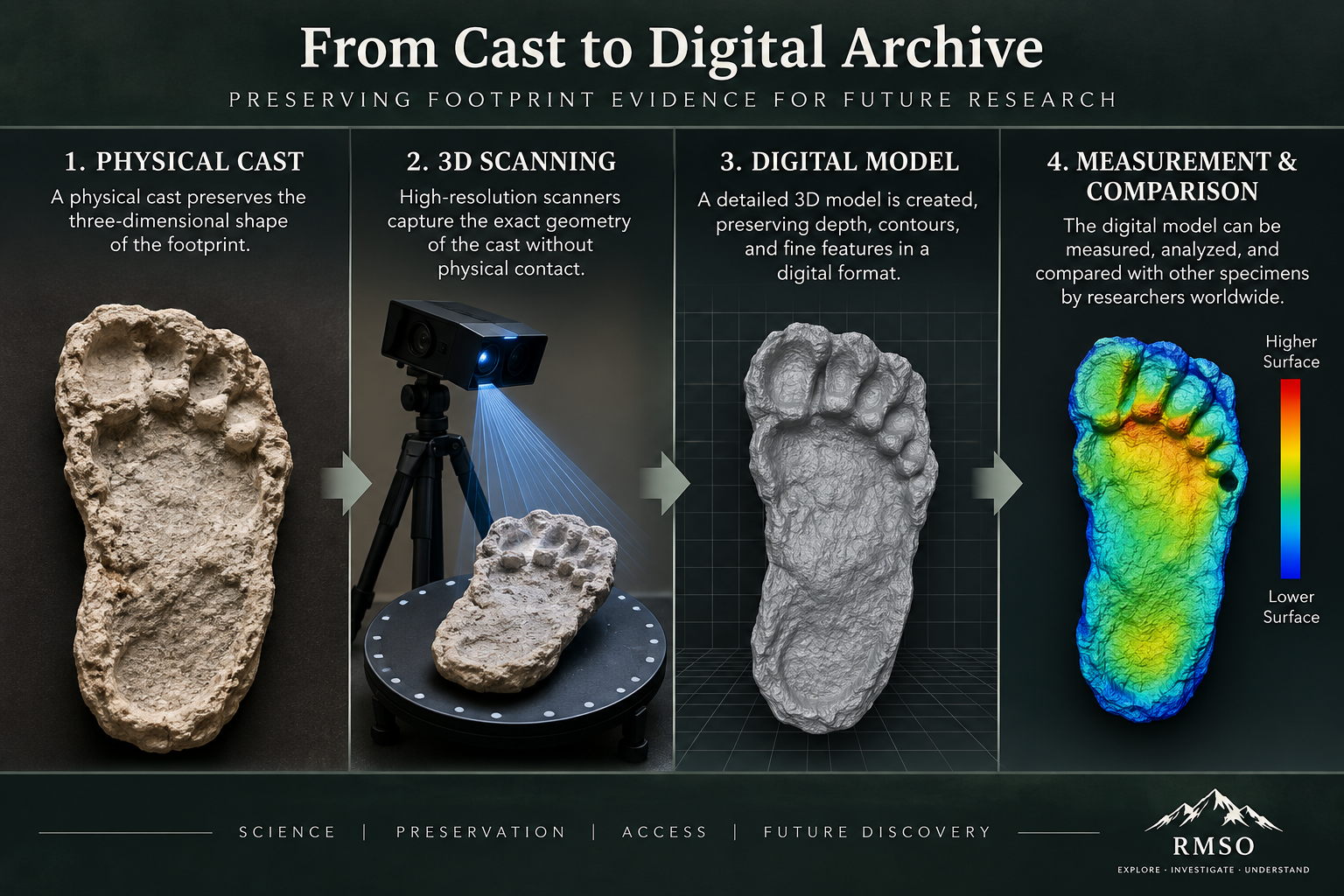
Educational illustration showing the process of preserving footprint evidence from a physical cast through 3D scanning, digital preservation, and measurement.
From Cast to Digital Archive RMSO educational illustration showing how a physical footprint cast can be preserved as a measurable three-dimensional digital model.

IDAHO STATE UNIVERSITY · POCATELLO, IDAHO

Preserving the Evidence

Physical footprint casts preserve information that can be difficult to recover from photographs alone. The three-dimensional shape of an impression records depth, curvature, surface contours, and the spatial relationship between features within the track.

Idaho State University's Virtual Footprints Archive was created to digitally preserve and make available three-dimensional scans and provenance information from footprint casts. The collection consists primarily of North American tracks and includes specimens gathered or studied by researchers and investigators including Jeff Meldrum, Grover Krantz, Paul Freeman, Cliff Barackman, and others.

The casts were scanned by technicians at the Idaho Virtualization Laboratory at the Idaho Museum of Natural History. Digital preservation allows a physical specimen to be examined without repeatedly handling the original cast and provides researchers access to three-dimensional representations that can be measured and compared.

Why this matters: A digital archive does not establish what created a footprint. It preserves the geometry and provenance of the surviving evidence so that the track can remain available for examination, comparison, and future analysis.

Examine the Archive

Idaho State University's Virtual Footprints Archive provides direct access to the collection and its available specimen information.

Visit the ISU Virtual Footprints Archive
Anatomy, Locomotion, and the Footprint Question

The scientific value of a footprint depends on more than its size. Shape, proportions, pressure, movement, and the mechanics of the foot can provide additional information about how an impression may have been produced.

Dr. Jeff Meldrum served as Professor of Anatomy and Anthropology at Idaho State University. His academic work included primate locomotion, evolutionary anatomy, the development of human bipedalism, and the analysis of fossil hominin footprints.

Meldrum applied that background to alleged Sasquatch footprints, assembling and examining a large collection of casts and photographs. Rather than relying primarily on footprint size, his research focused on recurring anatomical proportions and features that he interpreted as evidence of a foot functioning differently from the comparatively rigid, arched human foot.

Expertise does not establish the conclusion

Meldrum's background in anatomy, primate locomotion, and bipedalism makes his analysis relevant to the footprint question. It does not, by itself, establish that the tracks were produced by an unknown primate. His anatomical interpretations must still be evaluated against the physical evidence and competing explanations.

Reading a Footprint

A footprint contains more information than its overall length. Investigators examine the shape of the impression, the relationship between its features, the surface in which it was made, and — when multiple tracks are present — the pattern created by movement.

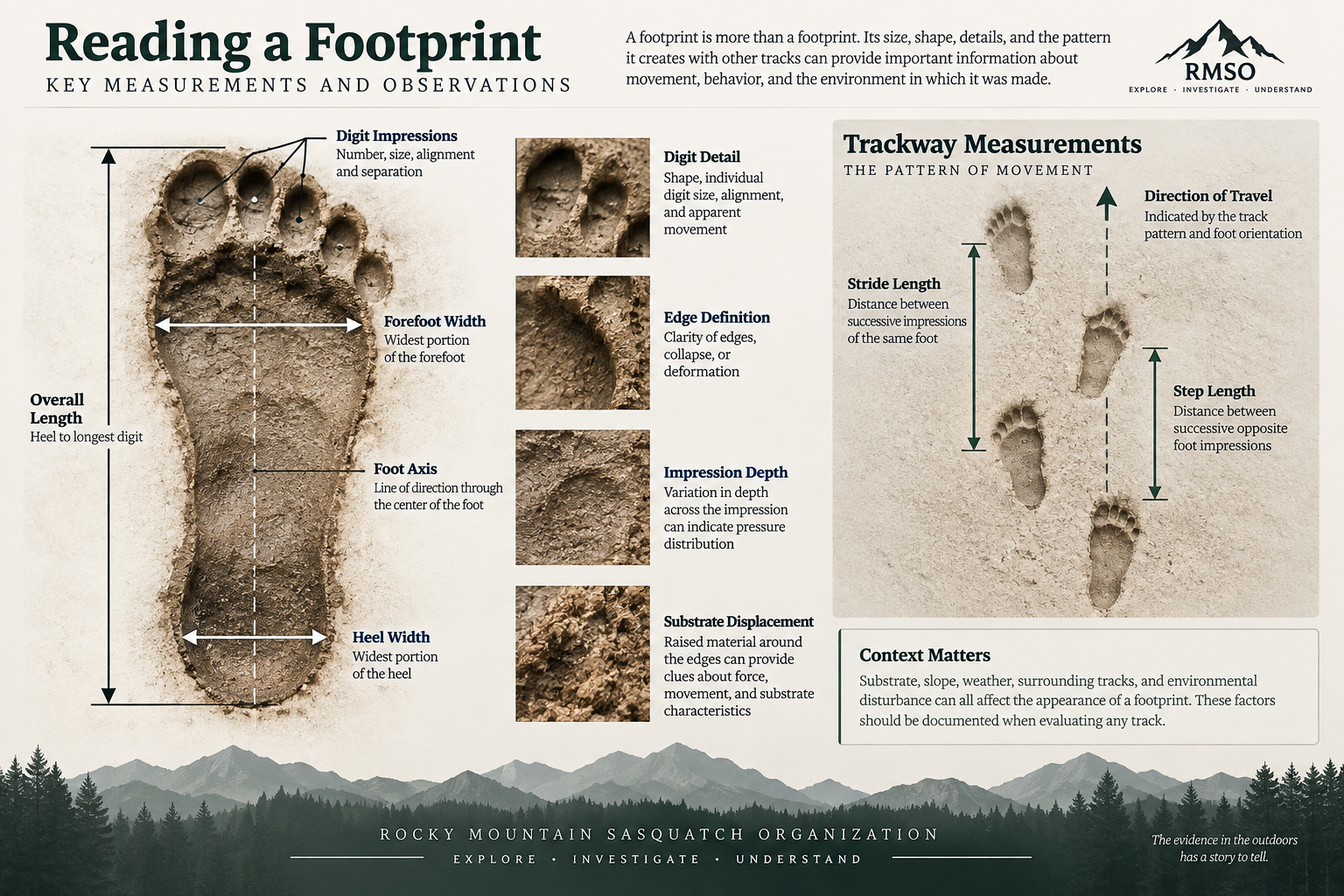
Measurements provide a repeatable way to describe a track. Overall length, forefoot width, heel width, digit position, and the orientation of the foot can be recorded before an impression deteriorates. Photographs taken with an appropriate scale preserve additional information about shape and context.

Interpretation becomes more complicated because a footprint is not a perfect mold of a foot. Soil composition, moisture, snow, slope, vegetation, movement, and the amount and direction of force applied to the surface can alter the resulting impression.

RMSO educational diagram showing common footprint and trackway measurements including overall length, forefoot width, heel width, foot axis, digit impressions, step length, stride length, and direction of travel.
Reading a Footprint RMSO educational illustration showing measurements and observations that can be documented when examining a footprint and surrounding trackway.

What Investigators Examine

Track Dimensions Length, forefoot width, heel width, and proportions
Digit Morphology Number, length, alignment, separation, and apparent movement
Impression Characteristics Depth, pressure, contours, displacement, and deformation
Trackway Pattern Step, stride, orientation, direction, and variation between impressions
Environmental Context Substrate, slope, weather, surrounding tracks, and disturbance
Measure before interpreting

Describing what is physically present before assigning an explanation helps preserve the distinction between observation and interpretation. Measurements, photographs, and field notes can later be reevaluated even when the original impression no longer exists.

The Midtarsal Question

Some alleged Sasquatch footprints contain transverse ridges, changes in pressure, or patterns that have been interpreted as evidence of unusual flexibility through the middle of the foot.

Dr. Jeff Meldrum has argued that certain examples are consistent with a foot that flexes through the midfoot differently from the typical modern human foot. In this interpretation, the resulting impression may preserve a transverse pressure ridge or other evidence of movement associated with midfoot flexion.

Meldrum has compared these features with the flexible feet of nonhuman primates and with features interpreted in some fossil hominin footprints. He has proposed that recurring examples among alleged Sasquatch tracks may represent a functional anatomical characteristic rather than simply an oversized version of the modern human foot.

A midfoot feature is an interpretation, not an identification

A transverse ridge or apparent point of flexion within a footprint does not by itself demonstrate the anatomy of the trackmaker. The feature must first be distinguished from effects produced by the substrate, human foot movement, track deformation, and artificial methods of producing footprints.

Meldrum's Interpretation

Meldrum argues that transverse pressure ridges and related features in some alleged Sasquatch tracks are consistent with greater functional flexibility through the midfoot than is typical of the modern human foot.

Of particular interest is whether similar features recur in independently collected tracks while remaining associated with other consistent aspects of footprint morphology.

What Must Be Tested

Human feet are themselves dynamic structures rather than completely rigid levers. Apparent midfoot features therefore must be compared with normal human variation and movement.

Investigators must also consider substrate deformation, differences in soil or moisture, movement within the track, preservation artifacts, and whether flexible artificial feet could reproduce similar impressions.

What Would Strengthen the Hypothesis?

Independent Examples Similar morphology appearing in unrelated, well-documented trackways
Dynamic Consistency Features changing predictably with movement, pressure, and substrate
Human Comparison Quantitative differences outside expected human variation
Experimental Testing Attempts to reproduce the features with known feet, prosthetics, and comparable substrates
Correlated Anatomy Multiple anatomical characteristics recurring together rather than relying on one feature

Trackways — Evidence in Motion

A single footprint records one moment. A trackway may preserve the pattern of movement.

From a Footprint to a Pattern

An isolated footprint can preserve shape, dimensions, and features of a single impression. A sequence of footprints adds another category of evidence: the relationship between successive steps.

Investigators can measure step length, stride length, step width, foot angle, direction of travel, and changes between individual impressions. Together, these observations can provide information about how the trackmaker moved through the environment.

Variation within a trackway can be particularly informative. A moving foot does not contact the ground identically with every step. Changes in terrain, balance, speed, direction, substrate, and loading can alter individual impressions. Investigators therefore examine both features that remain consistent and features that change throughout the sequence.

What a Trackway Adds

Step Pattern Distance and relationship between successive left and right impressions
Stride Repeated movement from one footprint to the next impression of the same foot
Track Width & Foot Angle Placement of the feet relative to the direction of travel
Dynamic Variation Changes in depth, orientation, toe impressions, and footprint shape between steps
Terrain Response Changes associated with slope, turns, obstacles, substrate, slipping, or changes in direction
Consistency and variation both matter

Repeated characteristics may help determine whether impressions belong to the same trackmaker. Variation can be equally important when it corresponds with changes in movement or terrain. Neither consistency nor variation alone establishes the identity of the individual that produced the tracks.

Original London Trackway Documentation — 2012

Original field photographs of the London Trackway are preserved in Cliff Barackman's 2013 paper, Footprint Evidence – The London Trackway. Figure 1a documents a portion of the trackway in situ, while Figure 1b provides a closer view of an individual footprint.

Photograph credit: Max Roy.
Research paper: Cliff Barackman, 2013.
Published in The Relict Hominoid Inquiry.
Source document hosted by Idaho State University.

View the Original London Trackway Photographs

FEBRUARY 2012 · LONDON, OREGON

A Trackway Under Examination

In February 2012, a sequence of large humanlike footprints was discovered in exposed sediment near Cottage Grove Reservoir outside the unincorporated community of London, Oregon.

Investigators documented 122 impressions along a trackway extending through muddy lakebed and adjacent sandy areas. Seventy-two of the available impressions were initially cast by Cliff Barackman and Chris Minniear, with additional casts subsequently produced by other investigators.

The investigation preserved more than individual footprint shapes. Measurements of the trackway, photographs of impressions in the ground, physical casts, and later three-dimensional scans provided several forms of documentation through which the sequence could be examined.

Why this case matters: The London Trackway provides a long sequence of impressions rather than an isolated footprint. This allows claims about anatomy and locomotion to be compared across successive tracks and tested against changes in movement and substrate.

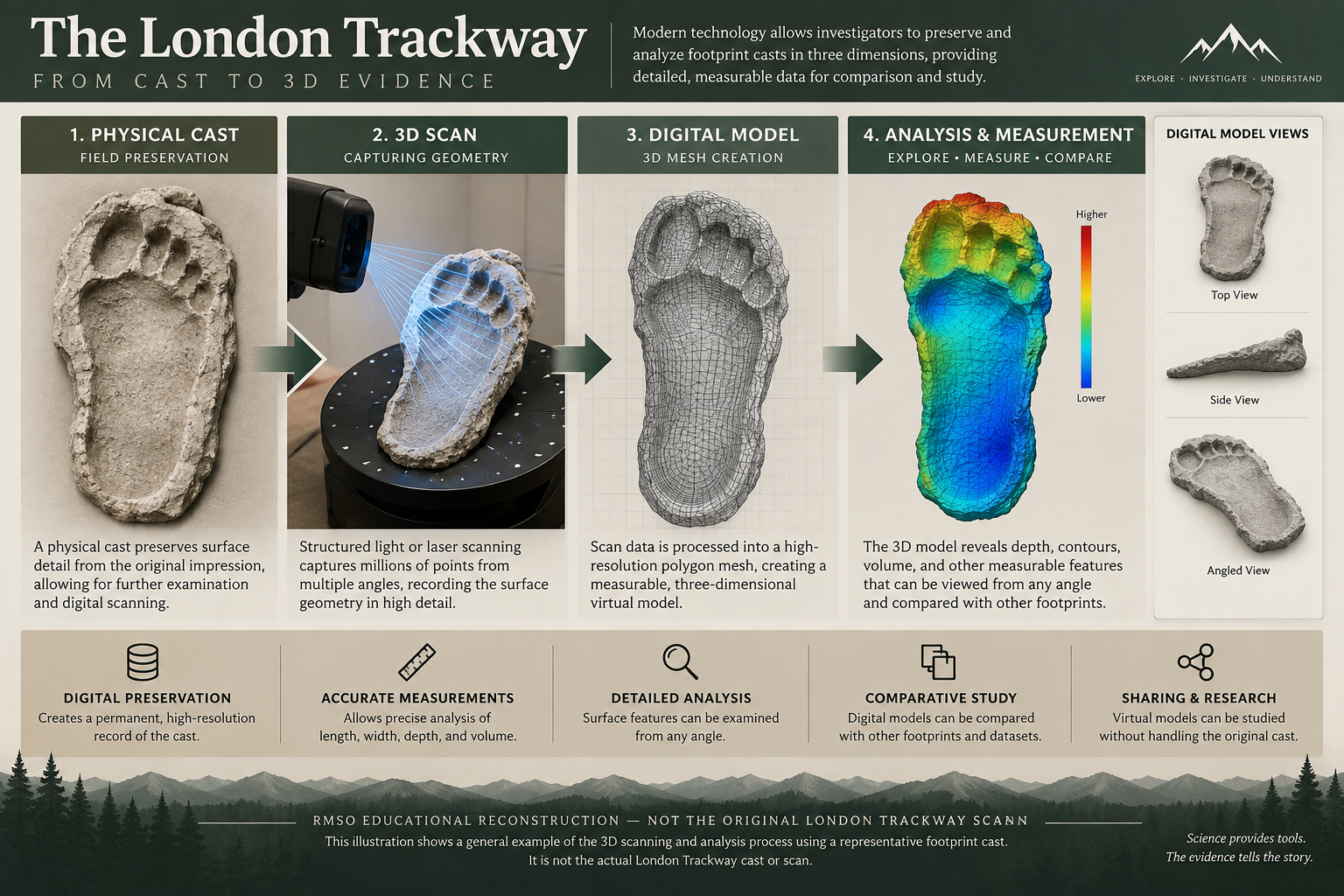
From Cast to Digital Evidence

Three-dimensional scanning allows a physical footprint cast to be preserved as a measurable digital surface. Instead of relying only on photographs, investigators can examine the geometry of the impression from multiple perspectives and compare features without repeatedly handling the original cast.

RMSO educational reconstruction showing a footprint cast progressing through 3D scanning, digital modeling, and measurement analysis.
London Trackway — From Cast to 3D Evidence RMSO educational reconstruction illustrating the three-dimensional scanning and analysis process. This is not the original London Trackway cast or scan.
Digital preservation does not authenticate the trackmaker

A three-dimensional model preserves measurable information about a cast. It can improve documentation, comparison, and access to the evidence, but it does not determine what produced the original footprint. Identification remains a separate question requiring analysis and comparison with competing explanations.

What the Trackway Preserves

The evidentiary value of the London Trackway does not rest on footprint size alone. Its importance lies in the quantity of successive impressions and the opportunity to compare characteristics throughout the sequence.

Documented Evidence

Trackway 122 sequential impressions were documented
Physical Preservation Numerous impressions were cast for later examination
Field Documentation Photographs and trackway measurements were recorded at the site
Digital Preservation Selected casts were later scanned in three dimensions at Idaho State University

What the Analysis Proposed

Barackman's analysis argues that variation among the impressions is consistent with a dynamically moving biological foot. Features discussed in the casts include apparent differences in digit position, toe-related structures, plantar tissue deformation, and changes associated with movement.

The paper further argues that the apparent spontaneity and variation throughout the trackway are difficult to reconcile with a simple rigid footprint prosthetic.

What Remains Unresolved

Demonstrating that impressions vary naturally does not establish the species or identity of the trackmaker. Substrate effects, human locomotion, fabrication techniques, and other mechanisms capable of producing variation must also be considered.

The paper presents the unknown-primate explanation as a hypothesis requiring further analysis. The available trackway evidence has not independently established that Sasquatch produced the impressions.

The distinction RMSO preserves

The London Trackway is a documented physical event. Its impressions, casts, photographs, measurements, and selected 3D scans can be studied. The biological identity of the individual responsible for producing the trackway remains an interpretation of that evidence.

Examine the Original Analysis

Cliff Barackman's 2013 analysis includes photographs, measurements, cast imagery, diagrams, and 3D scan material from the London Trackway.

Read the London Trackway Paper — Idaho State University

Evidence in Motion

The London Trackway becomes particularly interesting when individual impressions are examined as parts of a sequence. Instead of asking only what one footprint looks like, investigators can ask whether changes from one impression to the next correspond with movement.

Measurements reported in the original analysis produced an average step length of approximately 114.5 centimeters (45.1 inches). Individual measured steps ranged from about 83.8 to 137.2 centimeters, showing that spacing was not identical throughout the trackway.

The casts also preserved smaller variations. Barackman's analysis describes recurring striations in corresponding toe impressions, differences in the depth and orientation of individual digits, and changes in apparent toe position between successive tracks.

Reported Trackway Characteristics

Step Length Average approximately 114.5 cm, with substantial variation between measured steps
Toe Striations Recurring markings were reported on corresponding digit impressions
Digit Position Individual toe impressions varied in depth and apparent orientation
Plantar Features Some casts contained contours interpreted as deformation of soft tissue
Movement Event One portion contained a long sliding impression followed by unusual foot placement

When Variation Becomes Evidence

Variation within a trackway can contain useful information, but only when the variation can be connected to a plausible physical process. The central question is not simply whether the footprints differ — it is why they differ.

What Was Observed

Corresponding toe impressions reportedly contained recurring surface markings, while the position and depth of individual digits changed between some casts.

At least one cast contained an overhanging contour along several digit impressions. Another portion of the trackway contained a long sliding mark followed by unusual placement of successive footprints.

How It Was Interpreted

Barackman interpreted several of these features as evidence of a flexible biological foot, including independent toe movement and deformation of soft plantar tissue under load.

The sliding impression and subsequent footprints were interpreted as a momentary loss of balance, corrective foot placement, and change in direction.

Observation and interpretation are not the same thing

A ridge, striation, change in depth, or sliding mark can be documented directly. Describing that feature as a toenail, flexible digit, fat pad, or balance correction requires an additional anatomical or biomechanical interpretation. Those interpretations should remain open to comparison with substrate effects, human movement, fabrication methods, and other possible causes.

A Disruption in the Pattern

One portion of the London Trackway illustrates why a sequence can preserve information that an isolated footprint cannot.

At the position where the established step pattern suggested another left footprint should occur, investigators documented a long, narrow sliding impression approximately 61 centimeters in length.

Nearby ground disturbance and the placement of the next several footprints differed from the preceding pattern. Barackman interpreted the sequence as a slip followed by corrective foot placement, a change in orientation, and continuation of travel.

Why the sequence matters: An isolated sliding mark would provide little information about what caused it. Its position within a longer sequence allows investigators to compare what occurred immediately before and after the disturbance. That context makes the event testable as part of a locomotor pattern — while still leaving the identity of the trackmaker unresolved.

Hair, Biological Samples & DNA

Physical material can be tested in ways photographs and eyewitness reports cannot — but laboratory results are only as meaningful as the sample, its provenance, and the conclusions the evidence actually supports.

From a Sample to an Identification

Hair, tissue, blood, saliva, feces, and environmental DNA can contain biological information. Unlike a photograph or footprint, some biological material can be examined for characteristics that may identify its source or allow comparison with known species.

The existence of a physical sample, however, does not establish where it came from. A hair recovered near a reported sighting is first a hair of unknown origin. Its association with the report is part of the sample's provenance — not its biological identification.

Collection methods also matter. Biological material can be contaminated, degraded, mixed with material from other organisms, or separated from important information about where and how it was recovered. Careful documentation and preservation therefore begin before a sample reaches a laboratory.

What Gives a Biological Sample Evidentiary Value?

Provenance Where, when, and under what circumstances the sample was collected
Documentation Photographs, field notes, location, collector, and surrounding context
Preservation Storage and handling appropriate to the type of biological material
Contamination Control Procedures that reduce or detect material introduced during collection, handling, or laboratory analysis
Laboratory Analysis Reproducible examination using methods appropriate to the sample and research question
Comparison Results evaluated against suitable reference material or genetic databases
Location is not identification

Finding biological material at the location of an unexplained report does not establish that the material came from the reported subject. The biological source of the sample and its relationship to the reported event are separate questions that must be evaluated independently.

Unknown Is Not a Species

One of the most important distinctions in biological evidence is the difference between a sample that has not been identified and evidence demonstrating an unknown organism.

Unidentified

The available examination has not established the source of the material. This may occur because the sample is degraded, insufficient, contaminated, outside the scope of the test, or unable to be resolved using the available reference material.

Identified

The available evidence supports assignment of the material to a known biological source at the level permitted by the method — for example, a species, taxonomic group, or individual.

The critical distinction: A result that cannot identify a sample is not, by itself, evidence of an undiscovered species. Before such a conclusion could be considered, limitations of the sample, analytical method, contamination controls, and available reference data would need to be addressed.
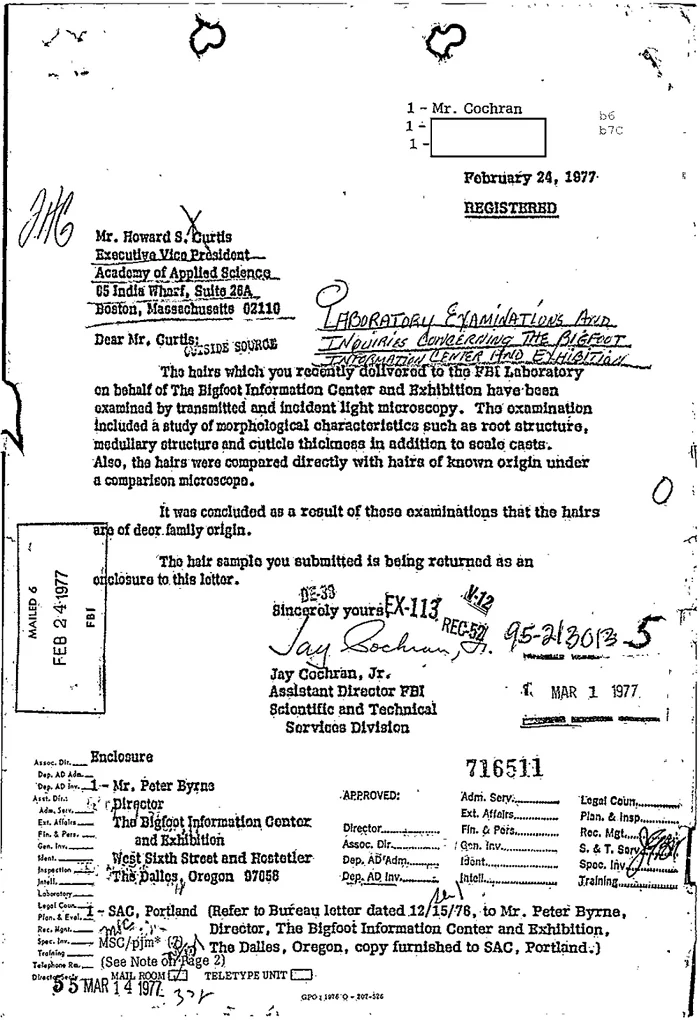
February 24, 1977 FBI Laboratory letter reporting the examination of hairs submitted in connection with a Bigfoot investigation.
FBI Laboratory Examination — February 24, 1977 Official FBI record released through the FBI Vault. The laboratory reported that the submitted hairs were of deer-family origin. View the Original Record — FBI.gov

1976–1977 · FBI LABORATORY

The FBI Bigfoot Hair Examination

In 1976, Bigfoot researcher Peter Byrne contacted the Federal Bureau of Investigation while attempting to determine whether the FBI had previously examined hairs reportedly associated with Bigfoot.

The correspondence eventually resulted in a hair sample being delivered to the FBI Laboratory on behalf of the Bigfoot Information Center and Exhibition.

Unlike many historical accounts surrounding alleged biological evidence, the outcome of this examination survives in the FBI's own records.

Why this case matters: The significance of the FBI record is not that the Bureau confirmed Bigfoot evidence. It is that a submitted sample was examined using documented laboratory methods and the laboratory reported a specific biological conclusion.

What the FBI Actually Tested

On February 24, 1977, the FBI reported the results of its examination in a letter to Howard S. Curtis of the Academy of Applied Science.

According to the laboratory letter, the submitted hairs were examined using transmitted and incident-light microscopy. Investigators studied several morphological characteristics and directly compared the sample with hairs of known origin.

Documented Laboratory Examination

Microscopy Transmitted and incident-light examination
Root Structure Morphology of the hair root was examined
Medullary Structure Internal characteristics of the hair were examined
Cuticle Cuticle thickness and scale casts were examined
Comparison Submitted hairs were compared directly with hairs of known origin
The reported result

The FBI Laboratory concluded that the submitted hairs were of deer-family origin. The sample was then returned to the submitter.

What the Result Does — and Does Not — Establish

What the Record Supports

A physical hair sample associated with a Bigfoot investigation was submitted to the FBI Laboratory. The laboratory examined the sample using microscopic comparison methods and reported that the hairs were from the deer family.

The surviving correspondence therefore documents both the examination and the conclusion reached by the laboratory.

What the Record Does Not Establish

The examination does not demonstrate that every hair attributed to Bigfoot is deer hair, nor does it resolve the broader question of whether an unidentified primate exists.

It establishes the reported identification of this particular submitted sample using the examination described in the FBI record.

The larger lesson: Evidence should be allowed to eliminate an extraordinary explanation when the evidence supports an ordinary one. A sample does not become less valuable to an investigation simply because testing identifies a known species.

Examine the Primary Record

The FBI has released its Bigfoot correspondence and laboratory documentation through the FBI Vault.

View the FBI Bigfoot File — FBI Vault
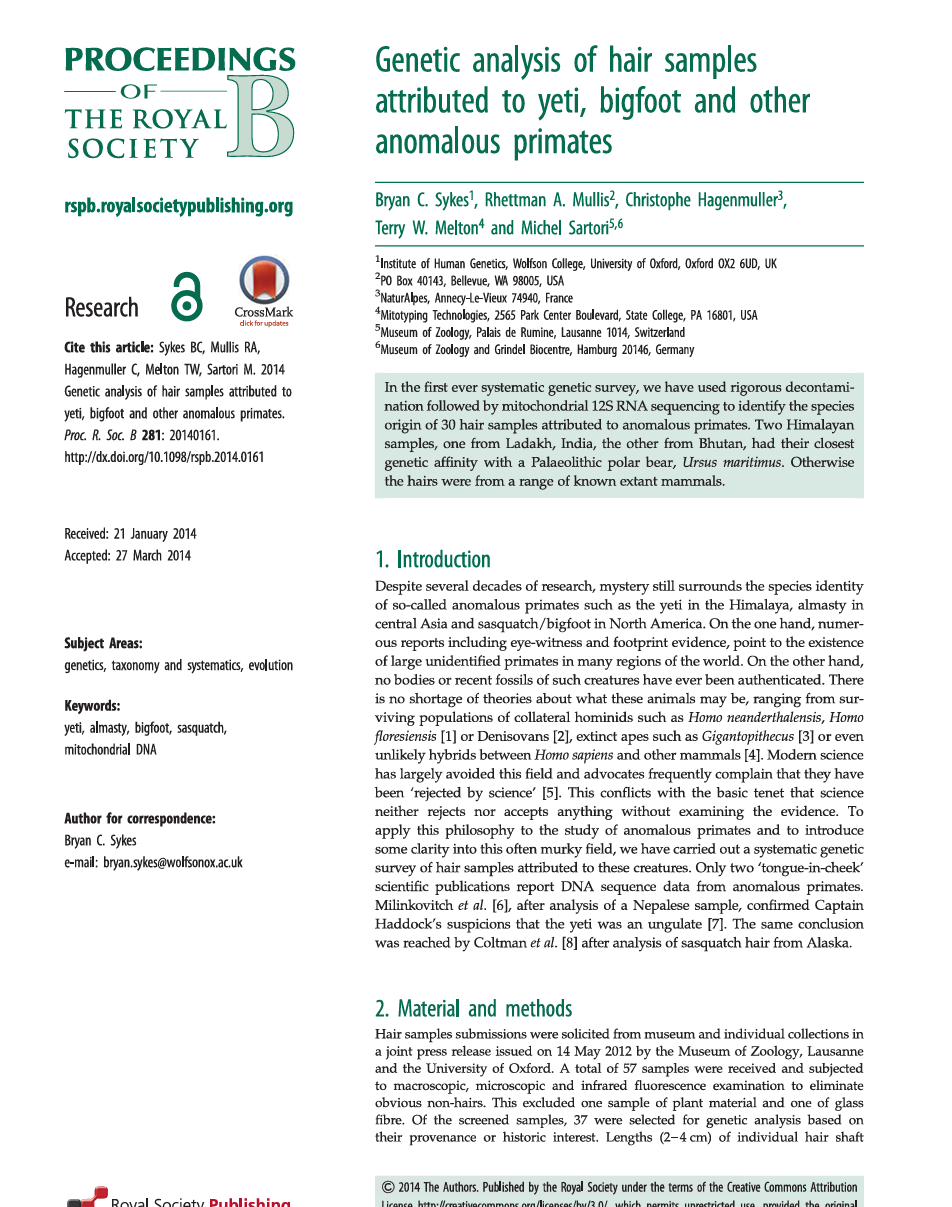
First page of the 2014 Sykes et al. peer-reviewed genetic study of hair samples attributed to Yeti, Bigfoot, Sasquatch, and other alleged anomalous primates.
Sykes et al. — 2014 First page of the peer-reviewed study Genetic analysis of hair samples attributed to yeti, bigfoot and other anomalous primates, published in Proceedings of the Royal Society B. Licensed under CC BY 3.0. Read the Published Study

2014 · GENETIC ANALYSIS

Testing Alleged Anomalous-Primate Hair

In 2014, Bryan Sykes and colleagues published a systematic genetic survey of hairs attributed to Yeti, Bigfoot, Sasquatch, Almasty, and other alleged anomalous primates.

The researchers received 57 submitted samples. Following initial examination, 37 were selected for genetic analysis based on factors including provenance and historical interest.

DNA sequences were successfully recovered from 30 of those samples. The researchers compared a mitochondrial DNA region from each successful sample with reference sequences in GenBank.

Why this study matters: Instead of relying primarily on the visible appearance of a hair, the investigation tested biological material using DNA sequencing and compared the resulting sequences against known genetic reference data.

What the DNA Identified

The successfully sequenced samples did not produce genetic evidence establishing an unidentified primate. Instead, the recovered sequences matched known mammals.

From Submission to Genetic Result

Samples Received 57 submitted samples
Selected for DNA Analysis 37 samples
Sequences Recovered 30 samples
North American Bigfoot Samples Successfully sequenced samples matched known mammals or human
Unidentified Primate DNA None established by the recovered sequences
What the study did not demonstrate

The results did not demonstrate that every biological sample ever attributed to Sasquatch comes from a known species. They established the genetic identities supported by the samples from which usable sequences were recovered in this particular study.

An Unexpected Result — and a Scientific Correction

Two Himalayan samples produced the most unusual result in the original study — and later demonstrated why genetic interpretations must remain open to independent review.

Hair samples from Ladakh, India, and Bhutan produced mitochondrial DNA sequences identified with polar bear genetic material. In the original 2014 paper, the researchers reported that the sequences matched DNA from a Pleistocene polar bear more than 40,000 years old.

That apparent result led the authors to discuss several possibilities, including an unrecognized bear population or historical hybridization between polar and brown bears.

Original Interpretation

The two Himalayan hair sequences were initially reported as matching genetic material recovered from an ancient Pleistocene polar bear.

Because the samples came from the Himalayas, the unexpected comparison raised questions about the identity and history of bears in the region.

Independent Reassessment

Other researchers reexamined the genetic comparison and found that the sequences also matched a modern polar bear from Little Diomede Island, Alaska.

The supposed exclusive connection with the ancient Pleistocene specimen was therefore incorrect.

Scientific correction strengthens the record: The correction did not erase the DNA sequences recovered from the samples. It changed an important interpretation of those sequences. Independent researchers checked the comparison, identified an error, and the original authors acknowledged it. This is an example of scientific self-correction rather than a failure of scientific inquiry.

Examine the Published Record

The original genetic study, subsequent critique, and authors' response are available through the scientific literature.

Environmental DNA & Field Collection

Modern genetic methods can detect biological material left behind in the environment — but obtaining a DNA sequence is only the beginning of determining what that evidence means.

DNA Without Seeing the Animal

Organisms leave biological material behind as they move through their environment. Environmental DNA, or eDNA, methods attempt to recover and identify genetic material contained in environmental samples rather than requiring the organism itself to be captured or observed.

Depending on the investigation, environmental samples may contain DNA originating from biological material deposited by organisms using an area. Laboratory methods can extract DNA from collected material, amplify selected genetic regions, and compare recovered sequences with reference data.

This makes genetic detection potentially valuable when investigating rare, elusive, or difficult-to-observe organisms. Its sensitivity, however, also creates one of its greatest challenges: DNA can be detected even when the circumstances surrounding its deposition are uncertain.

From Environment to Identification

1 · Collection Environmental material is sampled
2 · Preservation DNA is protected from degradation
3 · Extraction Genetic material is isolated
4 · Amplification / Sequencing Selected DNA regions are examined
5 · Comparison Recovered DNA is evaluated against reference data
6 · Interpretation Results are considered with controls, provenance, and environmental context
Detection is not the end of the investigation

Detecting DNA establishes that genetic material was detected in the tested sample under the conditions of the assay. Determining its biological source and what its presence means requires consideration of sampling, contamination controls, environmental transport, reference data, and independent confirmation.

The Investigation Begins Before the Laboratory

A sophisticated DNA laboratory cannot reconstruct information that was never recorded in the field. Collection procedures determine how confidently a later result can be connected to a location, event, or potential biological source.

The Sample

Record exactly what was collected, where it was found, when it was collected, and the environmental conditions surrounding the collection.

Samples should be clearly identified, preserved appropriately, and protected against degradation and cross-contamination.

The Record

Photographs, coordinates, date and time, collector identity, collection method, environmental conditions, sample identifiers, and subsequent handling create the provenance needed to interpret a laboratory result.

Transfers and handling should remain documented so that the history of the sample can later be reconstructed.

A DNA result cannot repair missing provenance: If the location, collection method, handling history, or contamination controls are unknown, even an unusual genetic result becomes substantially harder to interpret.

When Sensitivity Becomes a Problem

Modern DNA methods can detect extremely small quantities of genetic material. That sensitivity makes contamination control essential rather than optional.

DNA introduced by collection equipment, containers, investigators, laboratory procedures, or material carried from another sampling location can complicate a result. Environmental processes can also move DNA away from the organism that originally produced it.

Controls That Strengthen an Investigation

Clean Equipment Reduce transfer between samples and sites
Field Blanks Help reveal contamination introduced during collection
Laboratory Negative Controls Help reveal contamination during processing
Positive Controls Verify that the analytical process can detect its target
Replicate Samples Test whether a detection can be recovered consistently
Independent Confirmation Provides additional scrutiny of unusual results
A blank that produces DNA is evidence too

Negative controls are intended to contain no target DNA. If they produce an unexpected signal, that result can reveal contamination somewhere in the collection or laboratory workflow and must be considered when interpreting the associated samples.

What Would an Unusual DNA Result Actually Mean?

An unfamiliar sequence would be a reason to investigate further — not a reason to immediately name an unknown species.

What the Result Could Support

A properly controlled analysis could establish that a particular genetic sequence was recovered from a documented sample.

Comparison with reference databases could determine whether the recovered sequence is consistent with known organisms represented in those databases.

Questions That Would Remain

Could contamination, sequencing error, DNA degradation, assay limitations, or incomplete reference data explain the result?

Can the result be reproduced from the original material, replicated in additional samples, and independently confirmed?

Unknown DNA is not automatically an unknown animal: A sequence that cannot initially be identified describes the state of the analysis. Establishing a previously undescribed species would require substantially more evidence than an unmatched sequence alone.

Scientific Guidance & Field Methods

The principles described above are based on published environmental-DNA guidance and research from the U.S. Geological Survey and established biological evidence-preservation practices.

Audio Evidence & Vocalizations

A recording can preserve an unexplained sound long after an encounter ends — but determining what produced that sound requires more than simply listening to it.

From a Sound in the Forest to Recorded Evidence

Audio recordings can preserve characteristics of an acoustic event that human memory cannot: timing, duration, frequency content, repetition, amplitude relationships, and the sequence of sounds surrounding the event.

Those characteristics can be measured and compared. However, a recording preserves the sound reaching the microphone — not necessarily a direct representation of the source that produced it.

Distance, terrain, vegetation, echoes, wind, microphone response, automatic gain control, compression, and other recording conditions can alter how a sound appears in the resulting file.

From Recording to Interpretation

Original Recording Preserve the highest-quality original file
Context Record location, time, weather, equipment, witnesses, and surrounding activity
Acoustic Examination Measure duration, frequency, structure, repetition, and other observable characteristics
Comparison Evaluate known wildlife, human activity, mechanical sources, and environmental sounds
Interpretation Separate what the recording demonstrates from hypotheses about its source
A recording documents a sound — not automatically its source: An unusual vocalization can remain unidentified after analysis without establishing that it originated from an unknown species.

Preserve the Original Recording

The evidentiary value of an audio recording depends partly on preserving the original data and documenting where, when, and how the recording was made.

Original Recording

Preserve the original file produced by the recording device whenever possible. Editing, transcoding, noise reduction, normalization, and online-platform compression can alter acoustic information.

Copies prepared for public presentation should be treated as derivatives while the original remains preserved unchanged.

Recording Context

Document the date, time, location, recording device, microphone if known, weather, witnesses, direction of the sound, estimated distance, and relevant activity occurring before and after the event.

Notes made at the time of collection can preserve information that may be impossible to reconstruct months or years later.

Enhanced audio is not the original evidence

Filtering or amplification can make a recording easier to hear, but an enhanced version should remain distinguishable from the preserved original. Analysis should retain a clear path back to the unmodified recording.

Seeing the Structure of Sound

Acoustic analysis converts characteristics of a recording into measurements that can be examined independently of how unusual the sound seems to a listener.

Characteristics That Can Be Examined

Duration How long the sound or individual elements persist
Frequency The frequencies present and how they change through time
Harmonic Structure Relationships among fundamental frequencies and overtones
Modulation Changes in frequency or amplitude during the vocalization
Repetition Timing and structural similarity among repeated sounds
Background Context Other sounds occurring before, during, and after the event
A spectrogram is a measurement tool, not an identification: Visual differences in frequency or structure can help compare recordings, but an unusual spectrogram alone cannot establish the biological identity of the source.

Identification Requires Comparison

Before considering an unknown biological source, an investigation should examine whether known animals, human activity, equipment, or environmental processes can reasonably account for the recording.

Possible Known Sources

Wildlife vocalizations can vary with age, sex, season, alarm state, social behavior, distance, terrain, and recording conditions.

Human voices, vehicles, machinery, firearms, domestic animals, echoes, and other environmental sounds should also be considered when appropriate to the location.

Comparison Limitations

Failure to find an immediate match does not demonstrate that no known source can produce the sound. Reference collections may be incomplete, recording conditions may differ, and unusual behavior can produce unfamiliar vocalizations.

A defensible conclusion should reflect the strength of the comparison rather than the unfamiliarity of the sound.

Unidentified is a valid result: When available evidence cannot establish a source, the appropriate conclusion may simply be that the recording remains unidentified pending additional evidence.

ORIGINAL RECORDINGS

Sierra Sounds

“Fast Talk”

An excerpt from the Sierra Sounds collection featuring rapid, speech-like vocalizations attributed by the recordists to an unidentified source.

“Child's Play”

A second excerpt from the Sierra Sounds collection, providing another example of the vocal material associated with the reported encounters.

Audio streamed from the official Sierra Sounds collection maintained by Ron Morehead / Sierra Sounds Media LLC. RMSO does not host or modify these recordings.

Original Source — Sierra Sounds

1970s · SIERRA NEVADA, CALIFORNIA

The Sierra Sounds

Recordings made during a series of encounters in California's Sierra Nevada became known as the Sierra Sounds. Al Berry and others associated with the camp attributed the vocalizations to large, unidentified creatures reportedly encountered near the remote site.

What makes the recordings particularly useful as an evidence case study is not simply that the sounds are unusual. Portions of the recordings were later subjected to acoustic analysis using signal-processing techniques.

That analysis provides an opportunity to separate three different questions: what characteristics can be measured in the recording, what those measurements may suggest about the sound source, and whether the source itself can be identified.

Why this case matters: The Sierra Sounds allow the original recording and a published technical analysis to be considered together. The analysis can test characteristics of the recording without requiring the identity of the vocalizing source to be assumed.

From Listening to Measurement

In the late 1970s, electrical engineers R. Lynn Kirlin and Lasse Hertel examined a recording attributed to the Sierra encounters using signal-processing techniques. Their analysis was later published by the University of British Columbia Press.

Rather than attempting to identify the source by how the recording sounded to a listener, the researchers examined measurable acoustic characteristics including pitch, formant frequencies, and estimates of vocal-tract length.

What the Analysis Examined

Pitch Fundamental-frequency characteristics of recorded vocalizations
Formant Frequencies Resonant frequency patterns associated with the vocal tract
Vocal-Tract Estimates Estimates derived from acoustic measurements
Possible Speakers Variation among groups of vocalizations
Tape-Speed Manipulation Consideration of whether altered recording speed could account for unusual characteristics

What the Acoustic Analysis Found

Kirlin and Hertel analyzed a recording made on October 21, 1972. They examined individual vocal segments using signal-processing methods intended to estimate pitch, formant frequencies, and vocal-tract length.

Their objective was not simply to determine whether the sounds seemed unusual. They attempted to extract measurable characteristics from the recording and compare those characteristics with human speech data and possible recording-speed effects.

What the Authors Reported

The authors reported an average estimated vocal-tract length of approximately 20.2 centimeters across the analyzed data, which they considered significantly longer than that of a typical adult human male.

Using human body proportions as an extrapolation, their estimates produced possible equivalent heights ranging approximately from 6 feet 4 inches to 8 feet 2 inches.

They also found differences among groups of vocalizations that led them to consider the possibility of multiple speakers.

Important Qualifications

Some portions of the recording produced human-like measurements. The rapid “gob-gob” articulations, for example, produced human-like vocal-tract estimates, and the authors noted that their articulation suggested a human-like vocal tract.

Pitch measurements also overlapped the ranges of human male voices, particularly low-pitched male speech.

The measurements therefore did not establish that every vocalization originated from a non-human source.

Could Tape Speed Explain the Sounds?

Kirlin and Hertel specifically considered whether unusual vocal characteristics could have been created by recording or replaying ordinary speech at a different speed.

Changing tape speed alters both pitch and apparent vocal-tract measurements because the recorded frequencies shift together. The researchers therefore examined whether the measured combinations of pitch and estimated tract length behaved as expected under simple speed alteration.

Evidence Against Simple Speed Alteration

The authors reported that some combinations of pitch, articulation rate, and estimated vocal-tract length were not easily explained by simply slowing or speeding a recording.

They also reported no clearly identifiable speech when they played the recording backward.

Possibilities They Did Not Eliminate

The authors did not claim that every possible method of fabrication had been eliminated. They explicitly considered prerecording and more complicated, time-varying speed manipulation among the remaining possibilities.

Their conclusion was therefore evidence against certain simple manipulation explanations, not proof that fabrication was impossible.

A useful distinction: Failure to find the expected characteristics of a simple tape-speed alteration is not the same as proving that a recording could not have been fabricated by any method.

What the Sierra Sounds Establish

What the Record Supports

A high-quality recording attributed to the October 21, 1972 Sierra encounter was subjected to quantitative acoustic analysis by researchers trained in electrical engineering and signal processing.

Their published analysis identified measurable characteristics that they considered difficult to explain using an average human vocal model or simple tape-speed manipulation.

What the Record Does Not Establish

The analysis did not identify the biological source of the vocalizations. Some measured characteristics overlapped human ranges, and alternative explanations were not completely eliminated.

No independently documented organism was recorded simultaneously producing the analyzed sounds. The identity of the source therefore remains a separate question from the acoustic measurements.

RMSO assessment: The Sierra Sounds represent an unusually well-documented historical audio case because the recordings can be heard, measurable acoustic characteristics were subjected to published analysis, and the limitations of that analysis can also be examined. The recordings remain evidence of an acoustic event; the identity of the source is not established by the analysis alone.

Examine the Published Record

Kirlin and Hertel's analysis was published in Manlike Monsters on Trial: Early Records and Modern Evidence by the University of British Columbia Press in 1980, pages 274–290.

From Acoustics to Language?

Measuring pitch, frequency, and vocal-tract characteristics is different from determining whether a sequence of sounds constitutes language. Years after the original acoustic analysis, retired U.S. Navy cryptologic linguist R. Scott Nelson approached portions of the Berry/Morehead recordings from that second perspective.

Nelson transcribed speech-like portions of the recordings and argued that recurring sound units, articulation patterns, and repeated structures were consistent with organized communication rather than random vocalization.

To make those sounds easier to document and compare, he developed what he called the Sasquatch Phonetic Alphabet, also described as the Unclassified Hominid Phonetic Alphabet.

A different type of analysis: Kirlin and Hertel attempted to measure physical acoustic characteristics of a recording. Nelson's later work attempts to determine whether portions of the recordings contain recurring linguistic structure. Those are related, but fundamentally different, questions.

Turning Sound into a Transcript

Nelson argued that ordinary English spelling was poorly suited to documenting unfamiliar vocalizations because spelling does not consistently represent the sounds actually being produced.

His solution was to develop a transcription system based on the Berry/Morehead recordings. Individual sounds were assigned phonetic symbols so that recurring vocalizations could be written, compared, and examined across different portions of a recording.

Nelson's Analytical Approach

Listen Isolate speech-like vocal material
Slow Reduce playback speed to distinguish rapid articulations
Transcribe Represent individual sounds using Nelson's phonetic notation system
Compare Look for recurring sounds and sequences
Interpret Evaluate whether recurring structure is consistent with organized communication

A Phonetic Alphabet Is Not a Translation

Writing an unfamiliar sound and understanding what that sound means are two very different accomplishments.

Nelson's phonetic system attempts to represent the sounds he perceived in the recordings consistently. This allows one sequence to be compared with another without relying on approximate English spellings such as the popular description “samurai chatter.”

Transcription

A phonetic transcription attempts to record what sounds were produced and in what sequence.

Recurring sequences can then be identified and compared across recordings.

Translation

Translation requires establishing what words or structures mean within a language.

Without independently established meanings, speakers, context, or a verified language community, recurring phonetic sequences cannot by themselves provide reliable translations.

Structure does not automatically establish meaning: A recurring sequence may be important evidence of acoustic organization, but identifying repeated sounds is not the same as demonstrating vocabulary, grammar, or translation.

What Nelson Proposed — and What Remains Interpretation

Nelson's Interpretation

Nelson concluded that portions of the Berry/Morehead recordings contain a complex form of language. He based that interpretation on recurring phonetic elements, rapid articulation, perceived conversational exchanges, and structural patterns he identified while transcribing the recordings.

He developed a phonetic alphabet and transcription standard so that those patterns could be documented consistently and compared with future recordings.

What Remains Unresolved

Nelson's transcription standard is not a peer-reviewed linguistic demonstration that the recordings constitute an unknown language.

No identified population of speakers exists against which vocabulary, grammar, meaning, or transcription accuracy can independently be tested.

Recurring acoustic patterns may support further investigation, but they do not by themselves establish the biological identity of the vocalizer or demonstrate a previously unknown language.

Hypothesis versus verification: Nelson's work provides a systematic way to describe and compare speech-like portions of the recordings. His conclusion that those sounds constitute Sasquatch language remains an interpretation that has not been independently established by the existence of identified speakers or a validated linguistic corpus.

Examine the Linguistic Interpretation

Nelson's phonetic standard and statements about his analysis are publicly available. They are presented here as a later linguistic interpretation of the Berry/Morehead recordings, separate from the published Kirlin and Hertel acoustic analysis.

Photographic, Film & Video Evidence

When an image preserves more than an unidentified shape, it can become measurable evidence.

More Than a Picture

Photographic evidence is often judged by a simple question: does the subject look like a Sasquatch? A stronger investigation asks what information the recording actually preserves.

A photograph may preserve body proportions, scale relationships, lighting, environmental context, and anatomical features. Film and video can add another dimension: movement through time.

When enough information survives in the original media, investigators may be able to examine gait, stride, limb movement, changes in posture, interaction with the terrain, and relationships between the subject and stationary objects in the scene.

From Image to Evidence

Provenance Who recorded it, when, where, and on what device?
Original Media Is the original film, photograph, or digital file available?
Scene Geometry Can distance, scale, terrain, or reference objects be reconstructed?
Morphology Are body proportions or anatomical features measurable?
Movement Does motion preserve gait, stride, posture, or interaction with the environment?
Replication Can a proposed human or costume explanation reproduce the observed characteristics?
An important advantage of moving imagery: A single frame may contain an ambiguous shape. A sequence of frames can preserve changes in posture, limb position, balance, stride, and interaction with terrain. Those additional observations create more opportunities for competing explanations to be tested.

Complete Patterson–Gimlin film reel, October 20, 1967. RMSO archival reference copy obtained from Wikimedia Commons, which identifies the film as public domain in the United States.

Source, Provenance & Public-Domain Record — Wikimedia Commons

OCTOBER 20, 1967 · BLUFF CREEK, CALIFORNIA

The Patterson–Gimlin Film

Few pieces of evidence associated with the Sasquatch question preserve as much potentially measurable information as the film recorded by Roger Patterson at Bluff Creek.

The importance of the film is not simply that it shows a large, hair-covered biped. The subject is recorded through a sequence of movement, providing researchers with repeated views of posture, limb position, gait, body proportions, and interaction with the terrain.

More than half a century of examination has produced competing interpretations, but the film continues to support new analysis because measurable information remains preserved within the surviving film record.

Why this case remains important: The Patterson–Gimlin film is not merely an unidentified figure in a single photograph. It preserves a moving subject across many consecutive frames, allowing anatomical and biomechanical claims to be compared against the recorded imagery.

Why the Film Has Endured

The Patterson–Gimlin film has survived decades of scrutiny not because every question surrounding it has been answered, but because the recording contains enough information for competing explanations to continue being tested against it.

Evidence Preserved by the Film

Continuous Movement A walking subject is preserved across a sequence of frames
Body Proportions Limb, torso, head, and shoulder relationships can be compared across frames
Gait Stride, posture, knee movement, arm swing, and weight transfer can be examined
Surface Detail Some surviving film copies preserve information potentially relevant to body contour and apparent surface movement
Scene Context Terrain and environmental features provide reference information for reconstruction
Footprints Reported tracks and casts provide a second evidence category associated with the encounter

Before Analyzing the Subject, Analyze the Film

Anatomical measurements mean little if the underlying image has been altered, improperly copied, or contains artifacts mistaken for real detail.

In 2013, Bill Munns and Jeff Meldrum published an analysis focused specifically on the integrity and analytical usefulness of the Patterson–Gimlin film image.

Their investigation examined surviving film copies, possible splices, image resolution, focus, motion blur, copying artifacts, camera geometry, and the relationship between the moving subject and features of the original landscape.

Questions Tested Before Interpreting the Subject

Editing Do surviving copies contain evidence that the original sequence was deceptively spliced?
Resolution What level of anatomical detail can the film actually support?
Copy Generation Which visible features belong to the original image and which may have been introduced later?
Focus & Motion Blur Which frames preserve sufficient information for measurement?
Camera Geometry Can camera positions and subject movement be related to the physical scene?
Their conclusion: Munns and Meldrum concluded that the film copies they examined did not show evidence of deceptive alteration of the original filmed sequence and that the surviving imagery retained sufficient information for meaningful analysis.

Enhancement Can Reveal — and Create

Modern processing can make historical footage easier to watch, but an enhanced image is not automatically a more accurate image.

Original Evidence

The closest available generations of the original film preserve the photographic information actually recorded by the camera.

They should remain the reference against which enhanced versions are evaluated.

Analytical Derivatives

Stabilization, contrast adjustment, enlargement, sharpening, frame interpolation, and AI processing may make features easier to see.

They may also introduce pixels, contours, motion, or apparent details that were not independently resolved in the source material.

RMSO evidence standard: Enhanced imagery may be useful as an analytical aid, but conclusions should be checked against the highest-quality source material available. A detail visible only after processing should not automatically be treated as detail recorded by the original camera.

Examine the Higher-Resolution Presentation

The version below is a 1080p digital presentation of the Patterson–Gimlin footage. Its larger frame size can make the film easier to examine on modern displays, but the additional pixels do not represent additional detail recorded by the original camera.

Higher-resolution digital presentation of the Patterson–Gimlin film. RMSO preserves this separately from the primary reference copy because digital enlargement can improve viewing without increasing the resolving power of the original film.

Source, Provenance & Public-Domain Record — Wikimedia Commons

Testing the Human-in-a-Costume Explanation

If the subject was not an unknown biological animal, the principal alternative is that the film records a human performer wearing a costume.

That explanation is testable in principle. A successful reconstruction would need to account not merely for a hair-covered appearance, but for the combination of body proportions, apparent mass, gait, limb movement, surface contours, and movement preserved by the film.

Evidence Supporting Further Investigation

Analyses favorable to the film's authenticity have identified body proportions, movement patterns, apparent surface deformation, and other features they argue are difficult to reproduce with a conventional human performer and costume.

Forensic and image analyses have also failed to produce a universally accepted demonstration of how the complete recorded appearance and movement were fabricated.

What Remains Unresolved

Film imagery cannot independently identify the biological species of the subject, and measurements derived from the film depend on assumptions about scale, camera geometry, film generation, and other variables.

The absence of a demonstrated costume does not by itself establish that the subject represents an undocumented species.

The evidentiary question: A costume hypothesis becomes stronger when it can reproduce the characteristics visible in the film. The biological hypothesis becomes stronger when those characteristics remain difficult to reproduce while remaining consistent with natural anatomy and locomotion. Both explanations should therefore be evaluated against the same recorded evidence.

VISUAL EVIDENCE CASE STUDY

The Paul Freeman Footage

The Patterson–Gimlin film is not the only recorded Sasquatch case to preserve information that can be examined beyond a single image. Decades later, Paul Freeman recorded a large, apparently bipedal figure while investigating reported tracks in the Blue Mountains.

The Freeman footage presents a different evidentiary problem. Its image quality is substantially lower than the Patterson–Gimlin film, but the recording exists within a larger body of reported track evidence, footprint casts, field observations, and Freeman's continuing investigation of the area.

1994 · BLUE MOUNTAINS

Evidence Across More Than One Medium

The importance of the Freeman case does not rest entirely on the video. Freeman was already investigating apparent tracks in the region, and footprint impressions and casts form an important part of the larger evidentiary record associated with his work.

This creates an opportunity to examine several forms of evidence together. The moving imagery can be considered alongside reported tracks, casts, witness observations, environmental context, and Freeman's actions during the investigation.

Why this case matters: Strong investigations rarely depend upon a single observation. When tracks, casts, witness observations, environmental context, and moving imagery occur together, each can potentially be evaluated against the others.

Examine the Freeman Footage

The presentation below allows the recorded subject and its movement through the forest to be examined directly before considering the additional track and image analysis that follows.

Freeman footage presented through the Freeman Bigfoot Files project. Video remains hosted by the source publisher.

Freeman Bigfoot Files — Source & Additional Footage

The Camera Was Already Recording

The Freeman footage is often encountered as a short clip showing a dark figure moving between trees. The larger recording provides additional context surrounding the encounter.

Freeman was documenting apparent footprints and discussing the track evidence during his field investigation. The recording therefore preserves more than the brief appearance of the unidentified figure; it also preserves portions of the investigation surrounding the encounter.

That context does not establish what produced either the tracks or the recorded figure. It does, however, allow the footage to be considered as part of a larger sequence of observations rather than as an isolated video clip.

Evidence Preserved in the Freeman Case

Moving Imagery A large bipedal figure is recorded moving through forest
Tracks Apparent footprints were documented during Freeman's field investigations
Casts Freeman preserved footprint impressions during years of investigation in the Blue Mountains
Field Context Narration and movement through the area preserve portions of the investigation itself
Later Examination Researchers subsequently examined Freeman-associated footprint evidence and recorded imagery
Why context matters: Context cannot establish authenticity by itself, but it allows more questions to be asked. Investigators can examine what Freeman was doing around the time of the encounter, what evidence he believed he was following, and how the recorded subject relates to the larger field investigation.

A Case Built Around Tracks

Long before the footage became widely known, Paul Freeman had become associated with discoveries of large footprints in the Blue Mountains and with casts made from some of those impressions.

Portions of Freeman's footprint evidence attracted the attention of physical anthropologist Grover Krantz and later anthropologist Jeff Meldrum. Both considered examples from the larger footprint record sufficiently interesting to warrant continued examination.

Features discussed in connection with Freeman-associated impressions have included toe configuration, pressure features, apparent anatomical variation, and markings interpreted by some investigators as possible dermal ridge detail.

Why Some Researchers Took Notice

Krantz incorporated Freeman-associated tracks into his broader investigation of purported Sasquatch footprints and argued that some contained anatomical characteristics that deserved more serious consideration than a simple carved-foot explanation.

Meldrum later obtained a substantial collection of Freeman casts and has continued to examine examples within the broader record of reported Sasquatch footprints.

Why the Evidence Was Disputed

Other investigators questioned some of Freeman's track discoveries and proposed fabrication or misinterpretation. Particular trackways and impressions have therefore remained subjects of disagreement.

The evidentiary value of an individual cast should not be assumed simply because it belongs to the larger Freeman collection. Documentation and anatomical characteristics must be evaluated for each example.

One collection, many pieces of evidence: Freeman's footprint record should not be treated as one indivisible piece of evidence. Individual trackways and casts can differ in provenance, documentation, preservation, anatomical detail, and evidentiary strength.

What Can We Actually See?

The Freeman footage presents almost the opposite analytical problem from the Patterson–Gimlin film: potentially useful behavioral and contextual information is preserved, while fine anatomical detail is limited by the recording quality.

Information the Recording Preserves

The recording preserves a large upright figure moving between trees, changes in body position, apparent arm and leg movement, and portions of the subject's movement relative to the surrounding forest.

The larger recording also preserves Freeman's actions, narration, and portions of the field investigation surrounding the encounter.

Information the Recording Limits

Resolution, distance, vegetation, camera movement, focus, and the analog recording format limit reliable interpretation of fine anatomical features.

Apparent facial detail, fingers, muscle definition, surface anatomy, and similarly small features should therefore be treated cautiously, particularly when visible only after enlargement or enhancement.

Poor resolution does not mean no evidence: The useful question is not simply whether enhancement can make the subject appear clearer. It is which characteristics remain observable in the underlying recording and which apparent details emerge only after processing.

A Second Subject?

Later examination of another portion of the Freeman recording produced one of the case's more intriguing interpretations: that the larger figure may briefly interact with a smaller subject.

Enhanced presentations of the footage have been used to argue that a smaller figure becomes visible near the larger subject and is briefly lifted or carried.

Why the Interpretation Is Interesting

If independently supported by the underlying frames, interaction between two differently sized subjects would preserve considerably more behavioral information than a solitary figure moving through the forest.

It could also provide another sequence of movement against which human-performance, costume, and environmental explanations could be evaluated.

Why Caution Is Necessary

The interpretation depends heavily upon low-resolution imagery and later enhancement. Enlargement cannot recover anatomical information that the original recording failed to resolve.

Before treating a smaller figure as independently established, the proposed subject should be traceable through consecutive source frames rather than inferred primarily from an enhanced image.

A testable claim: The question is not simply whether an enhanced version appears to show a smaller subject. The stronger test is whether the proposed subject can be tracked consistently through consecutive source frames in a way that cannot reasonably be explained by vegetation, image noise, motion blur, or other artifacts.

Examine the Proposed “Baby Lift” Sequence

This enhanced presentation highlights the portion of the Freeman material interpreted as showing interaction between a larger and smaller subject. It should be considered an analytical presentation rather than a replacement for the underlying source imagery.

Enhanced presentation of the proposed “Baby Lift” sequence from the Freeman footage. Video remains hosted by the Freeman Bigfoot Files source publisher.

Freeman Bigfoot Files — Source & Additional Footage

RMSO FIELD INVESTIGATION

Returning to Freeman Country

For RMSO, the Freeman case is more than a historical recording studied from a distance. On multiple occasions, RMSO has conducted field investigations in the Blue Mountains area associated with Paul Freeman's research and reported encounters.

Establishing an exact historical filming position decades after an event can be difficult. Vegetation changes, landmarks can disappear, roads and trails change, and historical descriptions do not always preserve enough information to reconstruct a precise camera position. RMSO therefore does not claim that its field visits have established the exact location from which Freeman recorded his footage.

What those visits do provide is firsthand experience with the broader landscape in which Freeman conducted his investigations: its terrain, forest density, visibility, access, and the practical difficulties involved in searching and documenting evidence in the Blue Mountains.

What Field Investigation Adds

Terrain Firsthand observation of slope, elevation, drainage, and travel conditions
Vegetation Forest density, ground cover, concealment, and changing sight lines
Visibility Real-world understanding of how terrain and vegetation affect observation and photography
Access Practical experience moving through and investigating the surrounding landscape
Historical Context A better understanding of the environment in which Freeman conducted his field research
Field context is not historical verification: RMSO's visits to the Freeman area do not establish the identity of the figure recorded in the historical footage, nor do they establish the precise location from which every portion of the recording was made. Their value is different: they allow RMSO to examine the broader environment firsthand rather than evaluating the case entirely through photographs, video, maps, and historical accounts.

VISUAL EVIDENCE CASE STUDY

The Memorial Day Footage

On May 26, 1996, during a camping trip near Chopaka Lake in northern Washington, Lori Pate recorded a dark, apparently bipedal figure moving rapidly across a steep, partially open hillside.

The recording followed an earlier observation by members of the camping party. According to the witness account, the figure appeared again several minutes later farther up the mountain, where Lori was able to record portions of its movement across the hillside and toward the trees.

Unlike footage discovered later without surrounding documentation, the Memorial Day case includes identified witnesses, a specific date and location, reported additional observers, and subsequent attempts to reconstruct the subject's route.

Why this case matters: The recording can be evaluated together with witness observations and a physical landscape that investigators attempted to revisit and measure. That creates opportunities to test claims about movement, scale, speed, and terrain rather than relying entirely on visual appearance.

Examine the Memorial Day Footage

The recording below presents the footage captured during the May 26, 1996 encounter near Chopaka Lake in Washington. Watch the subject's movement across the hillside before considering the terrain reconstruction and competing analyses that follow.

Publicly available presentation of the 1996 Memorial Day footage attributed to Lori Pate. Video remains hosted by the external publisher. RMSO does not host or claim ownership of the original recording.

Read the Memorial Day Case Record — BFRO Report 2600

Movement Across the Hillside

One of the most interesting features of the Memorial Day footage is that the subject does not simply stand in view. It moves across a real landscape whose slope, vegetation, and distances can potentially be investigated.

Owen Pate reported returning to the area and attempting to trace the route taken by the recorded subject. A later BFRO investigation also compared freeze frames of the figure with footage of Pate attempting to duplicate its movement through the area.

What the Recording Preserves

The subject can be observed moving relative to stationary terrain and vegetation, providing potential reference information unavailable in an isolated photograph.

The witness account also identifies a route that investigators attempted to revisit, allowing claims about movement and scale to be compared with the physical scene.

What Complicates Measurement

Distance from the camera, limited resolution, vegetation, perspective, uneven terrain, and uncertainty about the subject's exact route can substantially affect estimates of height, speed, and stride.

Reenactments are most useful when camera position, route, scale, terrain, and measurement procedures are documented closely enough to reproduce the comparison.

When Image Analysis Disagrees

The Memorial Day footage also demonstrates an important principle of visual investigation: an analytical result can itself require testing.

A later skeptical examination argued that changes in the apparent color of the recorded subject were consistent with artificial fiber that had been dyed brown, supporting a costume explanation.

Critics of that interpretation pointed out that the recording medium, lighting, surrounding vegetation, and video processing could also influence recorded color. They argued that appropriate control tests would be needed before color behavior alone could identify the material covering the subject.

Costume Hypothesis

If the color response of the subject can be shown to behave like dyed artificial fiber under comparable lighting and recording conditions, that would provide evidence supporting a costume explanation.

Alternative Explanation

If the same apparent color shifts can be produced by the camera system, videotape, changing light, reflected vegetation, or later processing, the observation would not independently identify the subject's surface material.

Analysis must also be testable: An interpretation becomes stronger when the proposed effect can be reproduced under controlled conditions. Detecting an unusual image characteristic is the beginning of that investigation, not necessarily its conclusion.

What the Memorial Day Case Adds

What Is Well Documented

The case has a named date, location, videographer, witness account, reported additional observers, recorded movement across identifiable terrain, and subsequent attempts to examine the route.

The footage has also been subjected to competing interpretations rather than remaining an unexamined Internet video.

What Remains Unresolved

Image quality limits anatomical identification, and later analyses have produced conflicting interpretations of the subject and its apparent surface characteristics.

The recording therefore preserves an event that can be investigated, while the biological identity of the recorded subject remains a separate evidentiary question.

Examine the Case Record

The original witness account and later critical analysis allow readers to compare the reported event with competing interpretations of the footage.

What Makes Visual Evidence Stronger?

A photograph or recording does not become strong evidence simply because the subject is unusual. Its value increases when the circumstances surrounding the recording allow observations to be tested independently.

The Patterson–Gimlin, Freeman, and Memorial Day cases preserve different kinds of information. Together they demonstrate why visual evidence should be evaluated as more than a question of whether an image “looks real.”

Stronger Visual Evidence Preserves More Than an Image

Provenance Who recorded it, when, where, and under what circumstances
Original Media Access to the earliest and least altered recording available
Environment Terrain, vegetation, distance, scale, and other features that can be independently examined
Movement Consecutive frames that preserve gait, posture, position, and interaction with the scene
Corroborating Evidence Tracks, measurements, witness observations, or other independently documented information
Reproducible Analysis Methods and measurements that other investigators can examine and attempt to reproduce
The image is the beginning of the investigation: Visual evidence becomes more informative when investigators can move beyond appearance and ask measurable questions. Can the location be identified? Can scale be established? Can movement be reconstructed? Do proposed explanations reproduce the recorded characteristics? And do the same observations remain when another investigator examines the evidence?

None of those questions requires beginning with the assumption that the recorded subject is either Sasquatch or a conventional explanation. They provide a way to test what the recording actually preserves before deciding what explanation best accounts for it.

Physical Trace & Environmental Evidence

Structures, disturbances, and other traces left behind in the landscape

Evidence Without an Eyewitness

Animals frequently leave evidence of their presence without ever being seen. Tracks, nests, beds, scat, feeding signs, hair, damaged vegetation, and other disturbances can preserve information about activity that occurred before an investigator arrived.

Sasquatch investigations sometimes encounter another class of reported evidence: broken or twisted vegetation, arranged branches, unusual structures, possible bedding or nesting areas, impressions, and other changes to the surrounding environment.

These observations can be documented and investigated, but the existence of an unusual structure does not establish what created it. Weather, falling timber, snow load, animals, forestry activity, recreation, and deliberate human construction can produce environmental changes that initially appear unusual.

The first question is not “Did Sasquatch make this?” The first question is: What happened here? Establishing the physical characteristics of a disturbance before assigning a cause preserves observations that can later be compared against competing explanations.

VISUAL COMPARISON

Known Primate Behavior & an Unexplained North American Structure

Comparing an unexplained structure with documented animal behavior can help investigators identify characteristics worth examining. Visual similarity alone, however, does not establish that the structures share the same origin.

Ground nest constructed by a western lowland gorilla in Gabon
DOCUMENTED GREAT-APE BEHAVIOR

Western Lowland Gorilla Ground Nest

Gorillas are scientifically documented constructing sleeping nests from surrounding vegetation, including nests built directly on the ground. Researchers examine construction, vegetation use, location, condition, and associated biological signs when documenting these sites.

Western lowland gorilla ground nest near Sette Cama, Gabon. Photo by Jefe Le Gran, licensed under CC BY 2.0.

View image source & license
Reported possible nesting structure investigated on the Olympic Peninsula in Washington
NORTH AMERICAN FIELD OBSERVATION

Olympic Peninsula Reported Nest Structure

This structure is representative of unusual ground structures investigated on Washington's Olympic Peninsula as possible Sasquatch-associated nesting sites. Its construction provides characteristics that can be compared with known great-ape nesting behavior, but the identity of its maker has not been scientifically established.

Photo courtesy of the Olympic Project. Used with permission. Final photographer credit and image subject to confirmation by the Olympic Project.

Olympic Project
Why the comparison matters

Similar appearance does not establish common origin. It does provide investigators with measurable characteristics to compare, including construction, dimensions, material selection, vegetation breaks, layering, interweaving, location, and associated biological evidence.

Observation Before Interpretation

Environmental evidence is especially vulnerable to interpretation because investigators often arrive after the event that produced it. The physical trace remains, while the behavior that created it is no longer observable.

A useful field record therefore begins with characteristics that can be measured or photographed independently of any proposed explanation.

Document the Trace Before Explaining It

Location Where the evidence was found and its relationship to surrounding terrain
Dimensions Height, width, length, diameter, spacing, and orientation where applicable
Condition Freshness, weathering, decay, breakage, compression, or other observable characteristics
Materials Species and condition of branches, vegetation, soil, rocks, hair, or other material involved
Surroundings Nearby tracks, trails, scat, disturbed vegetation, roads, campsites, livestock, or human activity
Documentation Overview photographs, close photographs, scale, video, notes, and location information

A Trace Is Not Its Source

One of the most important distinctions in field investigation is the difference between documenting that something happened and identifying what caused it.

Observation

A sapling is bent and held beneath another branch. Several limbs are arranged against a standing tree. Vegetation is compressed into a defined area. A branch has broken several feet above the ground.

These are physical observations that can be photographed, measured, and preserved in field notes.

Interpretation

The sapling was intentionally bent. The branches form a marker. The compressed vegetation is a sleeping area. The elevated break was produced by a large upright animal.

These statements propose causes or behaviors. They require additional evidence beyond the existence of the physical trace itself.

Good documentation survives a change in interpretation: An investigator may eventually change their opinion about what produced a structure or disturbance. Measurements, photographs, location information, and field observations remain useful because they describe the evidence rather than depending upon the original explanation.

What Else Could Produce It?

Environmental evidence becomes more informative when investigators actively search for ordinary processes that could produce the same result.

This does not mean assuming that every unusual observation has a conventional explanation. It means determining which explanations can actually reproduce the physical evidence.

Alternative Causes Worth Testing

Weather Wind, snow load, ice, flooding, and falling timber
Wildlife Feeding, bedding, rubbing, climbing, nesting, trampling, and travel
People Recreation, shelters, trail marking, firewood gathering, hunting, and deliberate construction
Livestock Bedding, rubbing, browsing, trampling, and repeated movement through an area
Forestry & Land Use Cutting, thinning, equipment, road maintenance, and previous land-management activity
Unknown Cause Evidence remains unexplained when available observations do not support a defensible source identification
Eliminating one explanation does not automatically establish another: If wind appears unlikely to explain a structure, that finding reduces one possibility. It does not by itself identify the source. Each proposed explanation must be supported by evidence of its own.

Field Investigation References

Wildlife researchers routinely use tracks, scat, nests, beds, damaged vegetation, feeding signs, and other traces to identify animal activity. These established approaches provide useful principles for documenting unusual environmental evidence as well.

Tree Breaks, Twists & Structures

Broken saplings, twisted limbs, bent trees, crossed branches, and apparently arranged structures are frequently reported during Sasquatch field investigations. Some can appear immediately unusual, particularly when living vegetation has been bent, interlocked, or broken in ways that seem difficult to explain at first observation.

But forests continuously record the effects of weather, wildlife, falling timber, snow, people, and the growth of the trees themselves. Determining whether a structure is unusual therefore requires more than recognizing an interesting shape.

The physical characteristics of the disturbance must first be documented well enough that different explanations can be compared against the same evidence.

Shape alone is weak evidence: A branch forming an X, an arch, or an apparently deliberate arrangement may attract attention, but geometry by itself does not establish intent. The stronger evidence lies in how the vegetation was altered, what forces could have produced those changes, and whether surrounding evidence supports the same explanation.

Read the Break Before the Structure

Before asking why a branch was broken, investigators can examine how it failed. Living wood responds differently depending upon species, diameter, moisture, direction of force, and whether it was bent, twisted, pulled, crushed, or struck.

A particularly useful example comes from research on orangutan nest construction. Researchers found that orangutans frequently bend larger living branches until they partially fracture without completely separating. These stronger branches remain attached and become part of the supporting structure of the nest.

Smaller branches used for lining are handled differently. They may be bent, fractured, twisted, and completely detached. Researchers were able to reproduce characteristic fracture patterns experimentally by applying similar bending and twisting actions.

What to Record at a Break

Height Measure the break from the surrounding ground, not from an estimated visual reference
Diameter Record the diameter of the limb or trunk at the point of failure
Break Type Complete separation, partial fracture, split, crush, bend, or twist
Direction Record the direction of bending, displacement, and the final position of the vegetation
Condition Living, dead, decayed, weathered, recently exposed, or previously damaged wood
Fracture Surface Photograph exposed fibers, bark separation, longitudinal splitting, and signs of cutting or abrasion
Surrounding Damage Look for additional broken vegetation, impact marks, tracks, deadfall, or evidence of a larger disturbance
A break can preserve information about force: The fracture itself may contain more useful information than the shape ultimately formed by the branch. Recording the break before touching or moving the vegetation preserves details that may help distinguish bending, twisting, impact, cutting, decay, or other mechanisms.

Structure or Coincidence?

Forests naturally produce patterns. Fallen branches cross one another, saplings become trapped beneath deadfall, snow bends vegetation, and growing trees can preserve arrangements that appear surprisingly organized.

A stronger case for deliberate manipulation requires characteristics that are increasingly difficult to explain through those processes alone.

Features Worth Documenting

Multiple pieces of vegetation interacting within the same structure can provide more information than a single crossed branch.

Investigators should note whether branches remain rooted, whether material appears to have been moved from elsewhere, whether pieces are interwoven or mechanically locked, and whether multiple breaks appear related to the same construction.

Repeated structures displaying similar measurable characteristics may also justify comparison, particularly when their locations and environmental context are documented consistently.

Features That Require Caution

X-shaped branches, arches, leaning sticks, isolated bends, and other simple geometries can occur without deliberate construction.

Human activity must also be considered whenever an area is accessible to hikers, hunters, campers, forestry crews, children, or other visitors.

An arrangement appearing unlikely to be natural does not by itself identify who or what arranged it.

Intent and identity are separate questions: Evidence may eventually support the conclusion that vegetation was deliberately manipulated without establishing the identity of the individual or species responsible. Demonstrating construction would therefore be an important finding, but it would not automatically demonstrate Sasquatch activity.

What Known Great Apes Can Teach Us

Great apes demonstrate that large primates can leave recognizable patterns of vegetation manipulation behind without using manufactured tools.

Orangutans construct sleeping platforms by selecting branches with different mechanical properties for different purposes. Larger, stronger branches can be bent and partially fractured to create the supporting structure, while smaller branches may be detached and incorporated as lining.

Chimpanzees also construct sleeping platforms by bending, breaking, and interweaving vegetation. Researchers studying abandoned nests have been able to identify construction patterns and scars that remain after the animal has left.

What the Comparison Supports

Large primates are capable of deliberately bending, breaking, twisting, moving, and interweaving vegetation to construct functional structures.

Their activity can leave measurable evidence in branch selection, fracture patterns, structural arrangement, and surrounding vegetation.

What the Comparison Does Not Establish

Similarity between an unexplained forest structure and known great-ape construction does not establish that another primate created it.

The comparison provides testable characteristics to examine. Identification still requires evidence capable of distinguishing the proposed source from wildlife, people, weather, and other alternatives.

Comparison is useful when it produces measurements: Instead of asking whether an unexplained structure simply “looks like” something a primate might build, investigators can ask whether it contains comparable fracture patterns, material selection, structural organization, and evidence of deliberate manipulation.

RMSO FIELD INVESTIGATION

Documenting a Structure in the Field

When RMSO encounters unusual vegetation or a possible structure, the greatest opportunity exists before anything at the site is moved, handled, or collected.

A useful record should allow someone who was not present to understand what was found and, where possible, evaluate the same physical characteristics later.

RMSO Field Documentation Sequence

1 — Establish Context Photograph the entire site and surrounding environment before approaching closely
2 — Preserve Position Photograph components where they were found before moving or handling anything
3 — Add Scale Photograph important features with a ruler, measuring tape, or other known reference
4 — Measure Record dimensions, break height, branch diameter, orientation, spacing, and other relevant geometry
5 — Examine the Area Search for tracks, hair, scat, additional disturbances, human activity, and natural causes
6 — Record Location Preserve geographic and environmental context according to RMSO's field-recording practices
7 — Interpret Last Separate observations recorded at the scene from later hypotheses about how the structure formed
Document first. Investigate second. Interpret last. A structure that eventually receives a conventional explanation is not a failed investigation. Determining what produced an unusual observation is the purpose of the investigation.

Comparative Research

Research on known great-ape nest construction provides experimentally documented examples of branch selection, bending, fracture, twisting, interweaving, and structural organization. These studies provide useful comparisons for understanding what deliberate vegetation manipulation can leave behind.

Possible Nests & Bedding Sites

Large areas of compressed vegetation, woven branches, ground depressions, and apparently constructed resting places are sometimes reported during Sasquatch field investigations.

These observations deserve careful documentation because large mammals can leave recognizable resting sites behind. But a depression in vegetation is not automatically a nest, and a constructed nest is not automatically evidence of an unknown primate.

The useful question is whether the site preserves physical characteristics that distinguish deliberate construction from ordinary bedding, trampling, weather, falling vegetation, or human activity.

A resting place and a constructed nest are not necessarily the same thing: Flattened vegetation may show that something occupied an area. Deliberately bent, broken, transferred, or interwoven material may preserve additional evidence of construction. Those observations should be documented separately.

Construction Leaves a Pattern

Known great-ape nests demonstrate that a sleeping structure can preserve more than an impression where an animal rested. Construction itself can leave recognizable physical characteristics.

Chimpanzees build sleeping platforms by bending and breaking strong stems, pulling vegetation inward, and interweaving material into a thick supporting platform. The resulting surface is typically functionally concave, with the center forming the primary resting area.

Orangutans similarly construct a supporting foundation and may add smaller branches and foliage as lining. Research has documented additional elements in some populations, including pillows, covers, and more complex arrangements of vegetation.

Characteristics of Deliberate Construction

Foundation Structural vegetation supports the resting area rather than merely lying beneath it
Central Area A defined resting surface or depression can be distinguished from surrounding vegetation
Manipulation Vegetation may be bent, broken, twisted, transferred, or interwoven
Material Selection Different sizes or types of vegetation may serve different structural purposes
Construction Scars Broken stems, bent branches, stripped vegetation, and attachment points may remain after use
Organization Multiple manipulated components function together as a structure rather than occurring independently

Great Apes Do Build on the Ground

Great-ape sleeping structures are not limited to the tree canopy. Ground nesting is well documented, particularly among gorillas, and ground nests also occur in some chimpanzee populations.

Studies of western lowland gorillas have documented nests constructed directly on the ground from herbaceous and woody vegetation. The materials and style of construction can vary with habitat, available vegetation, weather, and local conditions.

Chimpanzees generally construct sleeping platforms in trees, but ground nesting has also been documented. The important lesson for field investigation is therefore not that one particular nest shape defines a primate, but that nest location and construction can vary with environment and behavior.

What Great-Ape Research Supports

Large primates can deliberately construct resting sites using surrounding vegetation, including structures built directly on the ground.

Nest location, construction style, vegetation selection, and structural complexity can vary between species, populations, habitats, and environmental conditions.

What It Does Not Establish

Finding a large depression or arranged vegetation in a North American forest does not establish that a primate produced it.

Known wildlife, people, weather, and other environmental processes must still be considered, and similarity to known ape behavior remains a comparison rather than an identification.

RMSO FIELD INVESTIGATION

When a Possible Nest Is Found

A possible bedding or nesting site should initially be treated as a scene rather than an object. The surrounding area may preserve evidence that is lost if investigators immediately enter the structure to measure or examine it.

Initial photographs should therefore document the site from outside the disturbed area. Investigators can then work inward while looking for tracks, hair, scat, trails, additional resting sites, broken vegetation, and other evidence that may help establish what occurred.

Document the Entire Site

Overall Shape Photograph and measure the complete disturbed or constructed area
Length & Width Record dimensions rather than estimating the apparent size of the occupant
Depth Measure compression or depression relative to surrounding undisturbed vegetation
Materials Identify vegetation and distinguish rooted, detached, dead, and living material
Construction Record bends, breaks, twists, interweaving, layering, and transferred material
Orientation Record direction and relationship to slope, cover, trails, water, and surrounding terrain
Associated Evidence Search for tracks, hair, scat, odor, feeding evidence, trails, and nearby disturbances
Human Indicators Look for cut vegetation, footprints, campsites, trails, cordage, tool marks, and other signs of human construction
Do not stand in the structure first: Entering a possible nest or bedding site before documenting its condition can destroy tracks, transfer hair and fibers, compress vegetation, and introduce the investigator's own biological material into an area that may later be sampled.

The Strongest Evidence May Be Around the Nest

A structure may suggest that something rested or constructed material at a location, but evidence surrounding the site may provide a better opportunity to identify its source.

Great-ape field researchers do not always identify the maker of a nest from architecture alone. Associated evidence can include hair, feces, odor, tracks, or other signs capable of strengthening a species attribution.

The same principle is valuable in Sasquatch investigation. A possible nest accompanied by a documented trackway, hair, biological material, or other independent evidence presents a fundamentally different investigative situation from an isolated patch of compressed vegetation.

Structure Alone

Documents that vegetation was compressed, manipulated, or arranged.

Depending upon its characteristics, the site may support an interpretation of deliberate construction.

It may still provide little information capable of identifying the builder.

Structure + Independent Evidence

Tracks may connect an animal's movement with the structure.

Hair, scat, or other biological material may offer an opportunity for species identification.

Multiple independent observations can be tested against one another rather than relying entirely upon the appearance of the structure.

Association must also be demonstrated: Finding hair or a track near a possible nest does not automatically establish that the same source created both. Distance, position, freshness, environmental conditions, and the relationship between the observations should all be documented.

Fresh, Old, or Somewhere Between?

Environmental evidence changes after it is created. Leaves wilt, exposed wood darkens, vegetation rebounds, broken material dries, and weather gradually alters the structure.

Great-ape field surveys routinely classify nests by age or condition because deterioration affects both identification and estimates of when animals occupied an area.

RMSO can apply the same principle without pretending that visual aging provides an exact construction date.

Indicators Worth Recording

Leaves Green, wilted, dry, decomposing, or absent
Exposed Wood Moisture, color, oxidation, weathering, and condition of fresh fracture surfaces
Vegetation Degree of compression, recovery, new growth, and seasonal condition
Debris Accumulated leaves, needles, snow, sediment, or other material deposited after formation
Associated Signs Relative freshness of tracks, scat, hair, broken vegetation, and nearby disturbances
Age estimates should remain estimates: Weather, plant species, season, shade, moisture, and local environmental conditions can change the rate at which a structure deteriorates. Recording observable condition is stronger than assigning an exact age without supporting evidence.

Comparative Nest Research

Great-ape nest research provides documented examples of deliberate vegetation construction, material selection, ground and arboreal nesting, field identification, and nest deterioration. These studies provide comparative methods rather than evidence that an unexplained North American structure was produced by a primate.

Scat & Other Biological Traces

Tracks and structures record what happened to the environment. Biological traces may provide something different: material that originated from the animal itself.

Scat, hair, tissue, blood, saliva, and other biological material can potentially preserve information about the organism that deposited it. Depending upon the sample and its condition, laboratory analysis may sometimes identify species, diet, genetics, or other biological characteristics.

That potential makes biological evidence especially valuable, but it also makes careful collection and documentation important. A sample without reliable provenance may still be biologically identifiable while providing little evidence about the event investigators originally hoped to understand.

Biological material and investigative context are different kinds of evidence: A laboratory may be able to determine what produced a sample. Field documentation is what helps establish where the sample was found, what other evidence surrounded it, and whether it can reasonably be associated with the event under investigation.

Scat Is More Than a Shape

Wildlife researchers routinely use scat as evidence of animal presence. Size, shape, contents, location, and associated tracks can sometimes help narrow possible sources before laboratory testing occurs.

Visible contents may also preserve information about diet. Hair, bone fragments, seeds, vegetation, and other material can provide clues about what an animal consumed.

Appearance alone, however, should not be treated as a definitive species identification. Diet, age, moisture, decomposition, individual variation, and environmental exposure can all affect how scat appears.

What to Document Before Collection

Location Record where the sample was found and its relationship to trails, tracks, structures, water, and other evidence
Overall Appearance Photograph the complete deposit before anything is disturbed
Scale Include a ruler or known reference so dimensions can be evaluated later
Dimensions Record length, diameter, quantity, and other measurable characteristics
Condition Note whether the material appears fresh, moist, dry, weathered, frozen, degraded, or disturbed
Visible Contents Record hair, vegetation, seeds, bone, insect activity, or other observable material
Associated Evidence Document nearby tracks, hair, trails, feeding signs, bedding areas, or other physical traces

VISUAL COMPARISON

Same Animal. Very Different Evidence.

Scat does not have a single appearance for each species. What an animal has been eating can substantially change the shape, color, consistency, and visible contents of what it leaves behind.

Black bears provide a useful example. Their varied diet can produce scat that is tubular and relatively firm or loose and filled with berries, seeds, vegetation, insects, hair, bone, and other recognizable material.

American black bear scat photographed on a trail in coastal California
AMERICAN BLACK BEAR

Fibrous & Vegetation-Rich

When feeding heavily on vegetation, black-bear scat may contain obvious plant material and can appear relatively formed or fibrous.

American black bear scat, Jug Handle State Natural Reserve, California. Photo by Sarah Stierch, licensed under CC BY 4.0.

View original image & license
Black bear scat produced during seasonal berry feeding at Seney National Wildlife Refuge
BLACK BEAR — BERRY DIET

Loose & Seed-Rich

During berry season, scat from the same species may become loose or poorly formed and contain large quantities of seeds, skins, and other recognizable fruit material.

Black bear scat during seasonal berry feeding, Seney National Wildlife Refuge, Michigan. Photo: Courtney Celley / U.S. Fish & Wildlife Service.

View original image & licensing
Appearance is evidence — but not an identification

Size, shape, color, consistency, and contents are useful observations. They can help investigators compare possible sources, but variation within a known species demonstrates why appearance alone should not be treated as definitive species identification.

Compare Known Black-Bear Scat

The North American Bear Center maintains examples of black-bear scat produced under different diets and describes how food influences appearance and contents.

North American Bear Center — Scat / Droppings National Park Service — The Scoop on Bear Poop

FROM FIELD OBSERVATION TO ANALYSIS

What Can a Biological Sample Tell Us?

A biological trace can preserve several different kinds of information. What investigators can actually learn depends upon the material recovered, its condition, its provenance, and the analytical methods available.

Field observations and laboratory results answer different questions. Visible characteristics can be documented at the scene. Contents may provide information about diet. Microscopic examination can reveal material difficult to characterize in the field, while recoverable genetic material may provide an opportunity for species or, under appropriate conditions, individual identification.

1 Observe Appearance
Size
Condition
2 Examine Seeds
Hair
Bone & vegetation
3 Analyze Microscopy
Biological material
Sample condition
4 Test DNA recovery
Genetic markers
Reference comparison
5 Interpret Species
Individual
Other supported findings

Different Evidence Answers Different Questions

Appearance Shape, dimensions, color, consistency, condition, and visible contents can be documented in the field
Dietary Evidence Seeds, vegetation, hair, bone, insects, and other material may provide information about what an animal consumed
Microscopic Examination Material too small to characterize reliably in the field may sometimes be examined and compared under magnification
Species Identification Recoverable DNA may allow genetic comparison with reference material from known species
Individual Identification With suitable samples and genetic markers, analysis can sometimes distinguish individuals within a species
Each conclusion requires its own evidence: Identifying the species represented by a biological sample does not automatically establish when it was deposited, why it was present, or whether the animal that produced it was responsible for nearby tracks, structures, sounds, or a reported encounter.

Noninvasive DNA in Wildlife Research

Wildlife researchers use naturally deposited scat as a noninvasive source of genetic material. Depending upon sample quality and methodology, DNA recovered from scat can contribute to species and individual identification and population monitoring.

U.S. Geological Survey — Scat as a Source of DNA for Population Monitoring

2024 · MOLECULAR IDENTIFICATION

When Appearance Gets the Identification Wrong

A field identification is a hypothesis that can sometimes be tested. Genetic analysis provides an independent way to compare what investigators believe produced a biological trace with biological evidence preserved in the sample itself.

In a 2024 study published in the Journal of Mammalogy, researchers tested a rapid molecular method for identifying mammal species from fecal DNA. Nine samples were analyzed using mitochondrial DNA sequencing and comparison with mammalian reference sequences.

The researchers successfully produced molecular species identifications for all nine samples. After the original sample identifications were revealed, eight of the nine molecular results agreed with the previous identifications. The remaining sample did not.

What Happened?

9 Samples Fecal DNA from nine mammals was examined using molecular species identification
9 Results Molecular species identifications were successfully produced for every sample examined
8 Agreements Eight molecular identifications agreed with the samples' previous identifications
1 Disagreement For the remaining sample, the genetic evidence indicated that the original identification was wrong
Why this matters: Field appearance can help investigators develop a hypothesis about what produced a biological trace. Laboratory analysis provides an independent way to test that hypothesis. When analytical evidence conflicts with the original identification, the interpretation should be reconsidered rather than preserved simply because it was the first explanation proposed.
Applied to an unexplained sample

An unusually large, unfamiliar, or otherwise unexpected deposit may justify careful documentation and collection. Its unusual appearance, however, is the beginning of the investigation rather than the conclusion.

If reliable testing identifies the sample as a known species, that identification becomes part of the evidence. If testing does not produce a reliable species identification, the result should be reported according to what the analysis actually established. An unidentified result does not, by itself, establish the presence of an unknown species.

Examine the Published Research

Frank and colleagues published the study in the Journal of Mammalogy in 2024. The research evaluated nanopore adaptive sampling as a method for identifying mammalian species using DNA extracted from scat.

Journal of Mammalogy — Rapid Molecular Species Identification of Mammalian Scat Samples

Finding It Nearby Is Not the Same as Linking It

Biological material becomes considerably more informative when its relationship to other evidence can be documented. Proximity alone, however, does not establish that two pieces of evidence came from the same source.

Scat discovered beside an unusual trackway may be important. But investigators should still document whether the material lies directly within or beside the trackway, whether their apparent condition is consistent, and whether other animals commonly use the same location.

Observation

A biological sample was discovered near a trackway, possible nest, structure, or reported encounter location.

Its position, condition, measurements, and surrounding evidence can be documented directly.

Interpretation

The sample was deposited by the same individual responsible for the other evidence.

That relationship may be a reasonable hypothesis, but it should remain separate from what was physically observed until supporting evidence establishes the connection.

Association is itself something to investigate: Strong evidence is not created merely by placing several unusual observations together. Their physical and temporal relationship should be documented so the proposed connection can also be examined.

From Field Sample to Laboratory Evidence

Once biological material is collected, the investigation changes. The question is no longer only what the sample looks like, but what biological information can actually be recovered from it.

Fecal material can contain genetic material and is used in wildlife research as a noninvasive source of DNA. The condition of the sample, environmental exposure, collection method, contamination, and analytical method can all affect what information can be recovered.

Collection should therefore be planned around the intended analysis whenever possible. The laboratory that may receive a sample should be consulted about collection, preservation, packaging, storage, and submission requirements before the evidence is altered or transported.

Collection method should follow the analytical goal: There is no single preservation method appropriate for every possible laboratory examination. A sample intended for genetic analysis may have different requirements from material intended for microscopic, chemical, dietary, or other examination. When practical, determine laboratory requirements before collecting the sample.

Related Evidence on This Page

The earlier Hair, Biological Samples & DNA and Environmental DNA & Field Collection chapters examine laboratory identification, contamination, genetic testing, and the difference between an unidentified sample and evidence for an unknown species.

The RMSO Field Evidence Protocol

Observe. Preserve. Document. Compare. Test.

Evidence Begins in the Field

The value of evidence is determined not only by what is found, but by what investigators preserve about the circumstances in which it was found.

A remarkable footprint without scale, an unusual structure without surrounding photographs, or a biological sample without reliable provenance may lose information that can never be reconstructed later.

RMSO's investigative approach therefore begins before an object is collected, cast, moved, enhanced, or interpreted. The first responsibility is to preserve what the scene can still tell us.

RMSO Investigative Sequence

1 — Observe Examine the scene before disturbing it and identify what can actually be observed
2 — Preserve Avoid unnecessary handling, walking through the evidence, moving objects, or altering the scene
3 — Establish Context Record location, terrain, weather, environment, access, and surrounding conditions
4 — Photograph Work from overall scene photographs toward increasingly detailed views before alteration
5 — Measure Replace visual estimates with dimensions, distances, orientation, scale, and repeatable observations
6 — Search for Association Look for tracks, hair, scat, structures, trails, disturbances, witnesses, recordings, or other independent evidence
7 — Consider Alternatives Compare the evidence with wildlife, environmental, human, mechanical, and other plausible causes
8 — Collect Carefully Collect physical material only after its original condition and location have been documented
9 — Preserve Provenance Maintain the relationship between the evidence, its location, collection circumstances, and subsequent handling
10 — Analyze Use appropriate specialists, laboratories, comparison material, and analytical methods
11 — Separate Observation from Interpretation Clearly distinguish what the evidence demonstrates from hypotheses about what may have produced it
12 — Preserve the Record Retain original photographs, recordings, notes, measurements, samples, analytical results, and relevant metadata

Follow the Evidence Wherever It Leads

Sasquatch investigation begins with an extraordinary question, but the methods used to investigate that question do not need to be extraordinary.

A footprint can be measured. A recording can be examined. A structure can be documented. A biological sample can be tested. Historical evidence can be traced to its source. Alternative explanations can be compared against the same observations.

Sometimes that process produces an ordinary explanation. Sometimes important information has been lost before an investigation begins. And sometimes evidence remains unresolved even after serious examination.

None of those outcomes requires changing the standard of evidence.

The goal is not to make the evidence prove Sasquatch. The goal is to preserve the evidence well enough, document it carefully enough, and examine it critically enough that it has the opportunity to tell us what it actually supports.

When Evidence Has an Explanation

Identifying a known animal, environmental process, human activity, photographic artifact, or other conventional source is a successful investigative result.

It removes one uncertainty and improves our ability to evaluate future evidence.

When Evidence Remains Unresolved

An unresolved result should remain unresolved until additional evidence supports a stronger conclusion.

Preserving that distinction allows future discoveries, improved analytical techniques, or new comparison material to reopen the question without rewriting what the original evidence actually showed.

Evidence first. Conclusion second. That principle allows RMSO to investigate the Sasquatch question seriously while giving readers the information necessary to evaluate the evidence for themselves.